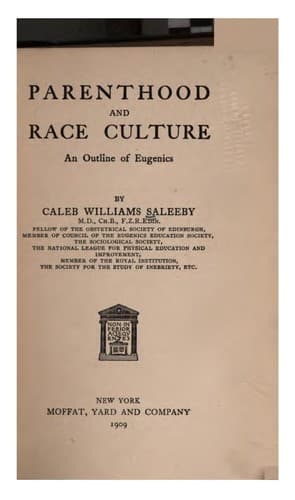
Parenthood and Race Culture: An Outline of EugenicsSaleeby, C. W. (Caleb Williams)
Philosophy
Parenthood and Race Culture: An Outline of Eugenics
Saleeby, C. W. (Caleb Williams)
Eugenics
=Psychical motherhood.=--I confess myself opposed to the principle
of bribing a woman to become a mother, whether overtly or covertly,
whether in the guise of State-aid or in the form of eugenic premiums
for maternity. It may sound very well to offer a bonus for the
production of babies by mothers whom the State or any eugenic power
considers fit and worthy. But though the bonus may help motherhood
in its physical aspects, the importance of which no one questions,
I do not see what service it renders to motherhood in its psychical
aspects--which are at least equally important. What is the outlook for
the baby when the bonus is spent? In fact, with all deference to Mr.
Galton, and with such deference as may be due to the literary triflers
who have discussed this matter, I am inclined to think that a cardinal
requisite for a mother is love of children. Ignorant this may be, and
indeed at first always is, but if it is there it can be instructed. The
woman who does not think the possession of a baby a sufficient prize is
no fit object, I should say, for any other kind of bribe or lure. The
woman who “would rather have a spare bedroom than a baby” is the woman
whom I do not want to have a baby. Thus I look with suspicion on any
proposals which assume that the psychical elements of motherhood are of
little moment in eugenics. I see no sign or prospect that they can be
dispensed with, and I think eugenics is going to work on wrong lines if
it proposes to ignore them. Even if you turn out Nature with a fork she
will yet return--_tamen usque recurret_.
In this question we should be able to derive great assistance from
biography. Real guidance, I believe, is obtained from this source, but
only a pitiable fraction of that which should be obtained. Scientific
biography is yet to seek, and it is the ironical fact that when Herbert
Spencer, in his _Autobiography_, devoted a large amount of space to
the discussion of _both_ his parents and their relatives, the literary
critics were bored to death. Nevertheless, we cannot know too much
about the ancestry, on both sides, and the early environment, of great
men. At present it is always tacitly assumed that a great man is the
son of his father alone. The biographer would probably admit, if
pressed, that doubtless some woman or other was involved in the matter,
and that her name was so and so--if any one thinks it worth mentioning.
On the score of heredity alone, however, we derive, men and women
alike, with absolute equality from both parents; and we cannot know too
much about the mothers of men of genius. Such knowledge would often
avail us materially in cases where the paternal ancestry offers little
explanation of the child's destiny.
Public-domain text, read in full here on John Shaqi.
Reviews
Reviews
No reviews yet
Be the first to share your thoughts on this work.
Elsewhere in the archive
Join the Discussion
Join the discussion
Sign in to leave a comment or review.
Sign InorCreate an account