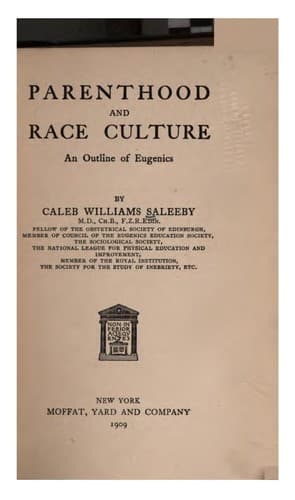
Parenthood and Race Culture: An Outline of EugenicsSaleeby, C. W. (Caleb Williams)
Philosophy
Parenthood and Race Culture: An Outline of Eugenics
Saleeby, C. W. (Caleb Williams)
Eugenics
This sufficiently indicates the dangers run by the eugenic principle
at the hands of those who see in it an instrument of protest and
rebellion against established things. We dare not repudiate the sacred
principles of protest and rebellion, which have been the conditions of
all progress, but believing in motherhood as we must, believing it to
be authorised by nature herself and not by any human conventions, we
must deplore any tendencies such as the two last cited. For us in this
country, however, a more immediate interest attaches to the views of a
much admired and discussed writer who claims to be a social philosopher
of the first order, and whose claims must now be examined.
The opinions of Mr. Bernard Shaw on the question of eugenics may be
quoted from his contribution to the subject published in _Sociological
Papers_ 1904, pp. 74, 75, in discussion of Mr. Galton's great paper.
Mr. Shaw begins by saying: “I agree with the paper and go so far as
to say that there is now no reasonable excuse for refusing to face the
fact that nothing but a eugenic religion can save our civilisation from
the fate that has overtaken all previous civilisations.” And further:--
“I am afraid we must make up our minds either to face a considerable
shock to vulgar opinion in this matter or to let eugenics alone....
What we must fight for is freedom to breed the race without being
hampered by the mass of irrelevant conditions implied in the
institution of marriage. If our morality is attacked, we can carry
the war into the enemy's country by reminding the public that the
real objection to breeding by marriage is that marriage places no
restraint on debauchery, so long as it is monogamic.... What we need
is freedom for people who have never seen each other before and never
intend to see one another again, to produce children under certain
definite public conditions, without loss of honour.”
The conception of individual fatherhood here stated involves a
deliberate reversion to the order of the beast: it excludes individual
fatherhood from any function in aiding motherhood or in serving the
future. It involves, of course, the total abolition of the family. It
denies and flouts the very best elements in human nature. It assumes
that the best women will find motherhood worth while without the
interest and sympathy and help and protection of the father. It does
not, however, condemn or exclude the psychical functions of motherhood,
since so far as this quotation goes it might be assumed that the mother
would be permitted to live with her own child. On this point, however,
Mr. Shaw offered us further guidance in his controversy with myself in
the _Pall Mall Gazette_, in December, 1907. One or two of his _dicta_
must here be quoted--they followed upon my remark, “Anything less like
a mother than the State I find it hard to imagine”:--
Public-domain text, read in full here on John Shaqi.
Reviews
Reviews
No reviews yet
Be the first to share your thoughts on this work.
Elsewhere in the archive
Join the Discussion
Join the discussion
Sign in to leave a comment or review.
Sign InorCreate an account