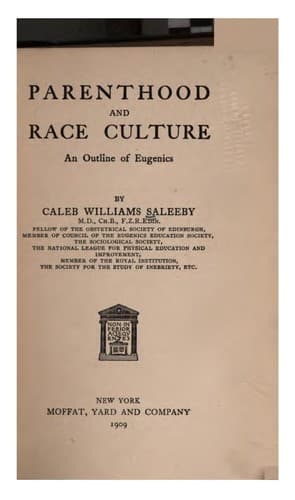
Parenthood and Race Culture: An Outline of EugenicsSaleeby, C. W. (Caleb Williams)
Philosophy
Parenthood and Race Culture: An Outline of Eugenics
Saleeby, C. W. (Caleb Williams)
Eugenics
It is the principle of survival-value that explains the dominance of
monogamy at all stages of human society--with the single exception
of continuously and wholly militant societies, in which polygamy
obtained in consequence of the great numerical excess of women. It is
the fate of the children, in which everything is involved, that has
determined the history of human marriage. Furthermore, we may see here
one more illustration of the truth that quality is ousting quantity in
the course of progress, and that a low birth-rate represents a more
advanced stage than a high birth-rate. The birth-rate under polygamy
is undoubtedly high, but polygamy does not make for the survival and
health of the children, and the infant mortality is gigantic. As I have
said elsewhere, “the form of marriage which does not permit the babies
to survive, _they_ do not permit to survive. There is the beginning and
the end of the whole matter in a nutshell. It is not a question of the
father's taste and fancy, but of what he leaves above ground when the
worms are eating him below.... No system yet conceived can compare for
a moment with monogamy in respect of the one criterion which time and
death recognise, the fate of the children.”
In a word, the wholly adequate and only possible explanation of
the historical fact of the dominance of monogamy is its supreme
survival-value. It has competed with every other kind of sex relation
and has been selected by natural selection because of its supreme
service for race-culture--the most perfect conceivable addition of
fatherhood to motherhood.
=Plato and motherhood.=--Thus eugenics must repudiate not only the
ideas of Mr. Shaw on this subject, but the teaching of Plato, from whom
Mr. Shaw's ideas on this particular subject are apparently derived. It
is in the fifth book of his _Republic_ that the pioneer eugenist lays
down his ideas for race-culture. He realised, indeed, the importance,
after birth, of the nurture of children--“it is of considerable, nay,
of the utmost importance to the State, when this is rightly performed
or otherwise;” and he refers also to their nurture while very young,
“in the period between their generation and their education, which
seems to be the most troublesome of all.” His method involved a
complete community of wives and children amongst the guardians of the
State, and on no account were the parents to know their own children
nor the children their parents. The best were to be chosen for parents,
on the analogy of animal race-culture by man. The children of inferior
parents were to be killed. The others were to be conveyed to the common
nursery of the city, but every precaution was to be taken that _no
mother should know her own child_. This practice was to be the cardinal
point of the Republic and “the cause of the greatest good to the city.”
Public-domain text, read in full here on John Shaqi.
Reviews
Reviews
No reviews yet
Be the first to share your thoughts on this work.
Elsewhere in the archive
Join the Discussion
Join the discussion
Sign in to leave a comment or review.
Sign InorCreate an account