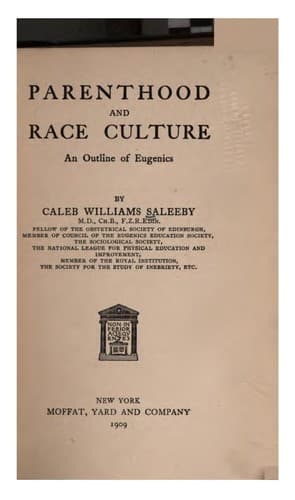
Parenthood and Race Culture: An Outline of EugenicsSaleeby, C. W. (Caleb Williams)
Philosophy
Parenthood and Race Culture: An Outline of Eugenics
Saleeby, C. W. (Caleb Williams)
Eugenics
In the first chapter of our second Part, which deals with the practice
of eugenics, there were introduced, defined, and briefly illustrated,
the terms _positive eugenics_ and _negative eugenics_. Of these the
latter, as the more urgent and the more completely and immediately
practicable, claims our special attention; though the present writer,
notwithstanding that he has devoted to it the greater part of his
eugenic work, is bound to protest that the positive increase of ability
and worth is never to be regarded as of secondary importance. The two
methods are, of course, complementary in practice, as they are one
in principle--to select is to reject, to choose is to refuse. The
preceding chapter, on selection (and rejection) through marriage, has
dealt with the conditions under which both aims are to be pursued.
In the following pages we must discuss a specially urgent and
practicable and indisputable portion of negative eugenic practice:
none the less urgent because of the contemporary emergence and future
world-importance of sober nations, such as Japan and Turkey. The term
_racial poisons_, introduced by the present writer in the year 1907,
is self-explanatory. After dealing with the most important of these
poisons, we shall proceed, in the next chapter, to discuss some others.
The racial poisons constitute a special department of eugenics which
has not hitherto been considered by the pioneers of this subject, but
for which I press the claim of the utmost gravity and moment, and which
I conceive to be certainly a part, and a most important part, of our
manifold yet single subject.
* * * * *
The argument of this chapter is that parenthood must be forbidden to
the dipsomaniac, the chronic inebriate or the drunkard, whether male
or female; and this whether Lamarck or Galton and Weismann be right,
or whether, as we may believe with Galton and Weismann themselves,
the controversy between the two parties is wholly irrelevant to the
question in hand. This conclusion, that on no grounds whatever,
theoretical or practical, can we continue to permit parenthood on the
part of the drunkard, is one temperance reform, perhaps the only one,
on which disagreement is absolutely impossible. It is, further, the
most radical that can be named within the sphere of practical politics,
and it is conspicuously practicable. It has hitherto been lamentably
neglected by workers and reformers of all schools. Indeed, at the time
of writing, the London County Council, governing the greatest city in
the world, is pursuing a course of action in this regard, which will be
detailed later, and which, as will appear, is misguided and deplorable
in the last degree.
Public-domain text, read in full here on John Shaqi.
Reviews
Reviews
No reviews yet
Be the first to share your thoughts on this work.
Elsewhere in the archive
Join the Discussion
Join the discussion
Sign in to leave a comment or review.
Sign InorCreate an account