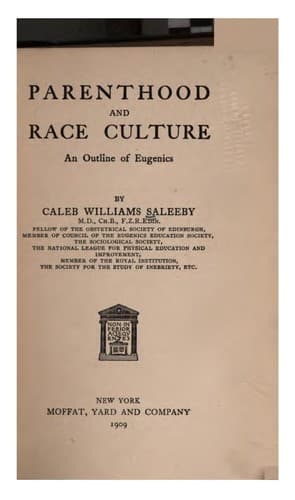
Parenthood and Race Culture: An Outline of EugenicsSaleeby, C. W. (Caleb Williams)
Philosophy
Parenthood and Race Culture: An Outline of Eugenics
Saleeby, C. W. (Caleb Williams)
Eugenics
It is impossible, within the scope of the present volume, to analyse
in detail the Report of the Royal Commission on the Care and Control
of the Feeble-minded. In this present outline of eugenics it is our
business, however, to show main principles, and as the principle
expressed in the phrase “racial poisons” is to my mind absolutely
cardinal for eugenics, it is necessary here to comment, as I have
already done in the _Journal_ above quoted, upon the following most
unfortunate deliverance of the Commissioners: “That both on the grounds
of fact and of theory, there is the highest degree of probability that
feeble-mindedness is usually spontaneous in origin--that is, not due to
influences acting on the parent....”
The word spontaneous has, of course, no meaning for science, or rather
is a denial of the fundamental axiom of science that causation is
universal. What the Commissioners mean when they say spontaneous is
“sportaneous,” like the occasional production of a nectarine by a peach
tree. Apart from this highly suspicious phraseology, there is the still
more unfortunate fact that the Commissioners have lent their authority
to the view that feeble-mindedness is not due to influences acting on
the parent. The modern student of syphilis will be astonished at this
pronouncement, and also the student of lead-poisoning, as we shall see
in the following chapter.
Every reader of Dr. Potts's admirable paper will realise that this
conclusion of the Commissioners--“not due to influences acting on the
parent”--is directly opposed to an extraordinary mass of evidence
and to the opinion of, I suppose, every authority on the subject,
British, Continental or American. The Commissioners' reference to
“theory,” coupled with portions of the evidence given before them by
witnesses who suppose that the alleged influence of alcohol as a cause
of feeble-mindedness controverts the doctrine of the non-transmission
of “acquired characters,” makes it necessary to point out for the
hundredth time that, for lack of analysis and criticism of terms,
the most prominent followers of Galton and Weismann persistently
misunderstand their masters' teaching. The modern doctrine of the
individual as the trustee of the germ-cells and of the non-transmission
of acquired characters is Mr. Galton's. Mr. Galton himself does not
question and never has questioned the possibility that alcohol may
cause feeble-mindedness. There is no reason why he should. If we take
the somewhat unusual course of consulting the words of the masters
before we swear by them, we find--as has been shown--that Weismann, who
subsequently stated and has so greatly supported Mr. Galton's view,
has expressly repudiated the Commissioners' idea of his “theory.” The
Galton-Weismann doctrine is a doctrine of heredity proper,--the organic
relation of living generations. It does not assert that there are two
unconnected universes--the one made of germ-plasm and the other of the
rest of nature.
Public-domain text, read in full here on John Shaqi.
Reviews
Reviews
No reviews yet
Be the first to share your thoughts on this work.
Elsewhere in the archive
Join the Discussion
Join the discussion
Sign in to leave a comment or review.
Sign InorCreate an account