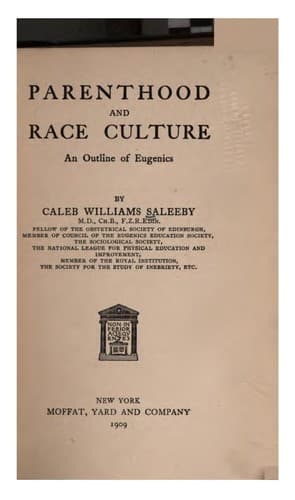
Parenthood and Race Culture: An Outline of EugenicsSaleeby, C. W. (Caleb Williams)
Philosophy
Parenthood and Race Culture: An Outline of Eugenics
Saleeby, C. W. (Caleb Williams)
Eugenics
The time will come when it is recognised that there are two classes
of active mind in society: those who worship and uphold the past, and
will always sacrifice the living to the dead, nay more, the unborn to
the dead. The ultimate fate of these is the fate of her who looked
backwards to the shame and destruction from which she had escaped.
She was turned into a pillar of salt. And there are those who worship
and work for the future, who will, without hesitation, sacrifice the
interests of the dead (who are no longer interested) to those of the
living and the coming race--nay, more, who will even sacrifice the
interests of a few worthless living to those of many yet unborn, _that
they may be worthy_. Let the dead bury their dead; let the worshippers
of the dead and the dying ask themselves whether the life that is and
the life that is to be do not demand their homage and service. Not
until some such principles as these are recognised shall we rightly
deal with the drink problem, amongst many others, and bring to it the
mental and moral enlightenment which makes for life on the higher
plane, just as surely and just as indispensably as the light of the sun
creates all life whatsoever.
=Mr. Balfour on legislation.=--Surely the moral of this argument is
clear. The most important, the most radical, the most practicable of
all temperance measures is that which attacks the main source of supply
of the drunkard. When a Licensing Bill is brought before the House of
Commons, Mr. Balfour repeats the ancient piece of nonsense that you
cannot make people moral by Act of Parliament--an assertion that any
child can see to be a muddle. We may let that pass for the moment,
but Mr. Balfour is a thinker, a student of biology, and heredity in
especial, and he has lately been lecturing on “Decadence.” Might it
not have been expected that such a man would take an opportunity to
say what the humblest serious student of the subject would have said,
and thereby to bring far more damaging criticism against the opposing
party's bill than any he hinted at? He might have said, “Your bill,
even if passed, will accomplish little, or relatively little, at great
cost, because you have no grasp of the principles of the subject. You
have no idea of what drunkenness really is. If your bill were worth a
straw it would seek as a primary principle to safeguard the race by
arresting the supply of potential drunkards. Your endless financial
clauses deal merely with the re-distribution of money, but your bill
has no clause that deals with the only business of governments, the
creation and the economy of the only real wealth, which is human life.”
That is what the ex-Premier did not say. He had plenty of passion,
plenty of party-feeling to give fire to his words, but so far as
knowledge is concerned or any conception of what alone is the wealth
of nations, there was nothing to choose between Mr. Balfour and Mr.
Asquith. Passion you must have if you are to do anything, but not
Public-domain text, read in full here on John Shaqi.
Reviews
Reviews
No reviews yet
Be the first to share your thoughts on this work.
Elsewhere in the archive
Join the Discussion
Join the discussion
Sign in to leave a comment or review.
Sign InorCreate an account