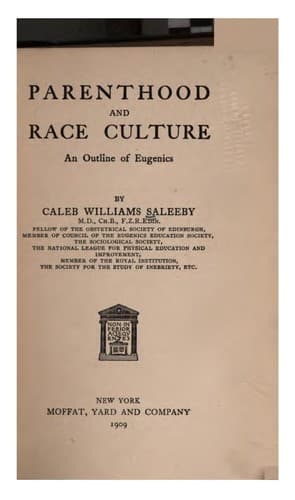
Parenthood and Race Culture: An Outline of EugenicsSaleeby, C. W. (Caleb Williams)
Philosophy
Parenthood and Race Culture: An Outline of Eugenics
Saleeby, C. W. (Caleb Williams)
Eugenics
This racial influence of lead is by no means generally recognised--even
by Royal Commissioners. Its parallelism with the case of alcohol is
striking. We may note, for instance, that paternal lead-poisoning,
like paternal alcoholism, can cause degeneration in the offspring, if
not indeed death before or shortly after birth. To quote Oliver again:
“Taking seven healthy women who were married to lead workers, and in
whom there was a total of thirty-two pregnancies, Lewin tells us that
the results were as follows: eleven miscarriages, one still-birth,
eight children died within the first year after birth, four in the
second year, five in the third, and one subsequent to this, leaving
only two children out of thirty-two pregnancies, as likely to live to
manhood. In cases where women have a series of miscarriages so long as
their husbands worked in lead, a change of industrial occupation on
the part of the husbands restores to the wives normal child-bearing
powers.” According to the statistical enquiry of Rennert, the malign
influence of lead is exerted upon the next generation, ninety-four
times out of one hundred when both parents have been working in lead,
ninety-two times when the mother alone is affected, and sixty-three
times when it is the father alone who has worked in lead. Here, then,
as in the case of alcohol, the racial poison may act either through
the father or through the mother, but especially through the mother.
The importance of the demonstration as regards the father in the
case of both poisons is that it means a poisoning of the paternal
germ-cell. The facts may be commended to those extremists, so much more
Weismannian than Weismann, who regard the germ-cells as existing in a
universe of their own, wholly unrelated to the rest of existence.
Another extremely interesting parallel between these two racial poisons
may be noted. It is found, according to Professor Oliver, that “while
following a healthy occupation these women, after having frequently
miscarried when working in lead factories, would have two or three
living healthy children, but circumstances necessitating the return of
these women to town, and resumption of work in the lead factory, they
in each successive pregnancy again miscarried.” He then quotes the
following most remarkable case: “Mrs. K., aged thirty-four, had four
children before going into the factory and two children after. She then
had six miscarriages in succession, when she came under my care in the
Royal Infirmary, having become the victim of plumbism and having lost
the power in her arms and legs. She made a slow but good recovery and
did not return to the lead works. In her next pregnancy she went to
full term and gave birth to a living child.”
Public-domain text, read in full here on John Shaqi.
Reviews
Reviews
No reviews yet
Be the first to share your thoughts on this work.
Elsewhere in the archive
Join the Discussion
Join the discussion
Sign in to leave a comment or review.
Sign InorCreate an account