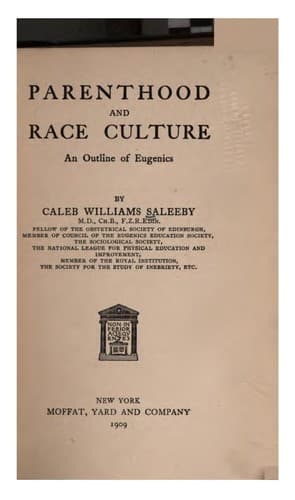
Parenthood and Race Culture: An Outline of EugenicsSaleeby, C. W. (Caleb Williams)
Philosophy
Parenthood and Race Culture: An Outline of Eugenics
Saleeby, C. W. (Caleb Williams)
Eugenics
=The two kinds of progress.=--Now in the case of all species other than
man, the only possible progress is this racial or inherent progress,
dependent upon a choice or selection of parents, and comparable in some
measure, as Darwin showed, with the change similarly produced in the
selective breeding or “artificial selection” of the lower animals by
man. But in the case of man himself, there is a wholly different kind
of progress also attainable, which is not inherent or racial progress
at all, but yet is real progress: and which has the most important
relations to the inherent or racial progress that might be achieved by
the process of natural selection, or the choice of parents.
It has been laid down that acquired characters are not transmissible
by heredity: but man has learnt--and it is well for him--to circumvent
the laws of heredity by transmitting his spiritual acquirements through
language and art. Even before writing there was tradition, passed on
from mouth to mouth. As long as man was without writing he advanced
little faster than other creatures, we may surmise: we know that he
has an undistinguished past of probably at least six million years:
but with speech _and writing_ came the transmission of acquirements
in this special sense; not that the past education of a mother will
enlarge her baby's brain, but that she can teach her daughter what she
has learnt, and so the child can begin where the parent left off, just
as Lamarck wrongly imagined to be the case with the young giraffe, that
he supposed to profit by the stretching of the parental necks. It is
this transmission of spiritual acquirements--outside the germ-plasm
and in defiance of its laws--that explains the amazing advance of man
in the last ten or twenty thousand years as compared with the almost
speechless ages before them.
This kind of progress is peculiar to man,[78] it is the gift of
intelligence, and we may call it traditional or acquired progress. It
is an utterly different thing from inherent or racial progress, an
improvement in the breed dependent upon the happy choice of parents.
And it is surely evident, on a moment's consideration, that acquired
progress is compatible with inherent decadence. To use Coleridge's
image, a dwarf may see further than a giant if he sits on the giant's
shoulders: yet he is a dwarf and the other a giant. Any schoolboy now
knows more than Aristotle, and that is true progress of a kind, but the
schoolboy may well be a dwarf compared with Aristotle, and may belong
to a race degenerate when compared with his; _and that is inherent or
racial decadence subsisting with acquired or traditional progress_.
Public-domain text, read in full here on John Shaqi.
Reviews
Reviews
No reviews yet
Be the first to share your thoughts on this work.
Elsewhere in the archive
Join the Discussion
Join the discussion
Sign in to leave a comment or review.
Sign InorCreate an account