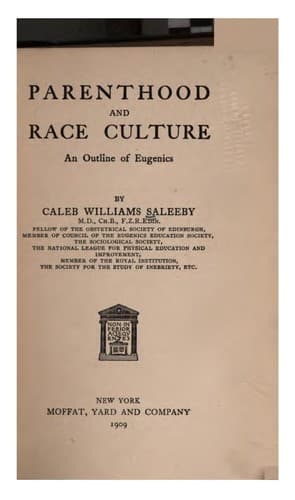
Parenthood and Race Culture: An Outline of EugenicsSaleeby, C. W. (Caleb Williams)
Philosophy
Parenthood and Race Culture: An Outline of Eugenics
Saleeby, C. W. (Caleb Williams)
Eugenics
But the historian might well write a volume upon the same thesis
as applied to China and Japan. We know historically what were the
immediate effects in one generation of a total change of environment in
Japan. That change has not yet occurred in China, but must inevitably
occur. Consider for a moment how the historian, made far-sighted
and clear-sighted by biology, must contemplate the history of this
astounding people. The popular belief used to be that China illustrated
the so-called law of nations. It was the decadent, though monstrous,
relic of an ancient civilisation; it had had its day. Inevitable
degeneration, which must befall all peoples, had come upon it. Behold
it in the paralysis which precedes death!
But in the light of the facts of Japan, the man in the street and the
historian alike have in this case found modern biology superfluous in
enabling them to arrive at sound conclusions. They now believe what
the Darwinian has been compelled to believe for half a century, and
more strongly than ever during the latter part of that period, when the
doctrine of the transmission of modifications was finally discredited.
A clever writer invents the phrase “the yellow peril,” and people
discard their old theories. The metaphor must be changed. This is not
paralysis, but merely slumber. Doubtless, it is an unnatural slumber;
doubtless, it is not the slumber which brings renewed strength. It
is suspense or stupor, not recuperation; but assuredly it is not
paralysis. Who now would dare to say that China has had its day, even
if he still clings to the old fictions about Spain?
=Motherhood and history.=--Here, also, reference must again be made
to another factor of history to which, as I think, the biologist must
attach enormous importance, but which no historian yet has adequately
reckoned with. Our prime assumption from beginning to end is that
“there is no wealth but life,” or, if one may venture to improve upon
Ruskin, _there is no wealth but mind_; and in the attempt to suggest
interpretations of history based upon this truth, so little recked of
by the historian, we have considered the life in question from the
point of view of its determination by heredity, and its varying value
according to the inherent and transmissible characters selected in each
generation. But a word must be said as to the other factor which, with
heredity, determines the character of the individual--and that factor
is the environment. I wish merely to note the most important aspect
of the environment of human beings, and to observe that historians
hitherto have wholly ignored it; yet its influence is incalculable. I
refer to motherhood.
Public-domain text, read in full here on John Shaqi.
Reviews
Reviews
No reviews yet
Be the first to share your thoughts on this work.
Elsewhere in the archive
Join the Discussion
Join the discussion
Sign in to leave a comment or review.
Sign InorCreate an account