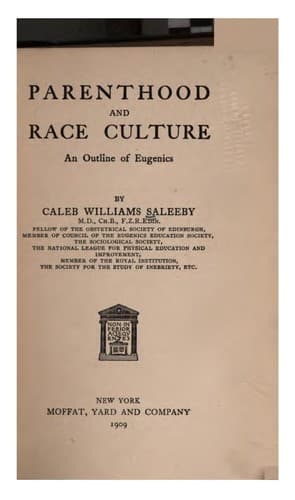
Parenthood and Race Culture: An Outline of EugenicsSaleeby, C. W. (Caleb Williams)
Philosophy
Parenthood and Race Culture: An Outline of Eugenics
Saleeby, C. W. (Caleb Williams)
Eugenics
Secondly, there was everything to favour motherhood. Here religious
precept and ethical tradition joined with stem necessity to the same
end--the end which always meant a new and strong beginning for the next
generation. Even to-day all observers are agreed that infant mortality
is at a minimum amongst the Jews; their children are superior in height
and weight and chest measurement to Gentile children brought up amidst
poverty far less intense in our own great cities; _in a better material
environment, but a far inferior maternal environment_. The Jewish
mother is the mother of children innately superior, on the average,
since they are the fruit of such long ages of stringent parental
selection, and she makes more of them because she fails to nurse them
only in the rarest cases, when she has no choice, and because in
every detail her maternal care is incomparably superior to that of
her Gentile sister. Given a high standard of motherhood in a highly
selected race, what other result than that we daily witness and envy
can we expect?
Thirdly, the Jews do not abuse alcohol, and thus avoid one of the few
causes of true racial degeneration apart from selection of the worst
for parenthood.
* * * * *
If these principles are valid, it is evident that our redemption from
the fate of all our predecessors is to be found only in Eugenics--the
selection of the best for parenthood. In his address to the
Sociological Society in 1904, in which he defined this term, Mr. Galton
named as one of the duties before the Society, “historical enquiry
into the rates with which the various classes of society (classified
according to civic usefulness) have contributed to the population at
various times, in ancient and modern nations.” “There is strong reason
for believing,” he continued, “that national rise and decline is
closely connected with this influence.”[81]
Public-domain text, read in full here on John Shaqi.
Reviews
Reviews
No reviews yet
Be the first to share your thoughts on this work.
Elsewhere in the archive
Join the Discussion
Join the discussion
Sign in to leave a comment or review.
Sign InorCreate an account