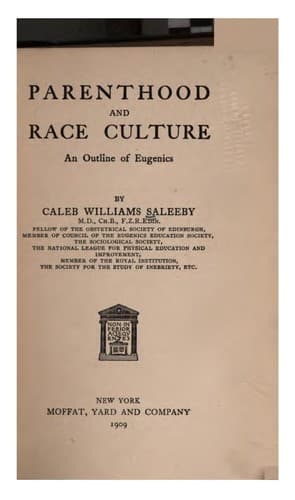
Parenthood and Race Culture: An Outline of EugenicsSaleeby, C. W. (Caleb Williams)
Philosophy
Parenthood and Race Culture: An Outline of Eugenics
Saleeby, C. W. (Caleb Williams)
Eugenics
Obviously the existence of men of most various types is a necessity
for any highly organised society. Even if eugenics were capable--as
it is not--of producing a complete and balanced type, fit up to a
point to turn out a satisfactory poem, a satisfactory symphony or a
satisfactory sofa, the utmost could not be expected of such a man in
any of these directions. In a word, as long as their activities are
not anti-social, men cannot be of too various types. We require mystic
and mathematician, poet and pathologist. Only, we want good specimens
of each. “The aim of eugenics,” says Mr. Galton, “is to represent
each class or sect by its best specimens; that done, to leave them
to work out their common civilisation in their own way.... Special
aptitudes would be assessed highly by those who possessed them, as the
artistic faculties by artists, fearlessness of enquiry and veracity by
scientists, religious absorption by mystics, and so on. There would be
self-sacrificers, self-tormentors, and other exceptional idealists.”
But at least it is better to have good rather than bad specimens of
any kind, whatever that kind may be. Mr. Galton thinks that all except
cranks would agree as to including health, energy, ability, manliness
and courteous disposition amongst qualities uniformly desirable--alike
in poet and pathologist. We should desire also uniformity as to the
absence of the anti-social proclivities of the born criminal. So much
uniformity being granted, let us have with it the utmost conceivable
variety,--more, indeed, than most of us can conceive.
This point, of course, is cardinal from the point of view of practice.
No progress could be made with eugenics, it would be impossible even
to form a Eugenics Education Society, if each of us were to regard the
particular type he belongs to as the ideal, and were to seek merely to
obtain the best specimens of that type. The doctrine that it takes all
sorts to make a world--a doctrine very hard for youth to learn, yet
unconsciously learnt by all who are capable of learning at all--must be
regarded as a cardinal truth for the eugenist. But he wisely seeks good
specimens rather than bad. Poets certainly, but not poetasters; jesters
certainly, but not clever fools, who stand Truth on her head and then
make street-boy gestures at her.
Public-domain text, read in full here on John Shaqi.
Reviews
Reviews
No reviews yet
Be the first to share your thoughts on this work.
Elsewhere in the archive
Join the Discussion
Join the discussion
Sign in to leave a comment or review.
Sign InorCreate an account