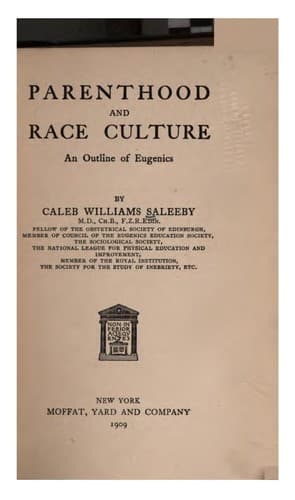
Parenthood and Race Culture: An Outline of EugenicsSaleeby, C. W. (Caleb Williams)
Philosophy
Parenthood and Race Culture: An Outline of Eugenics
Saleeby, C. W. (Caleb Williams)
Eugenics
This is a three-volume treatise, extremely comprehensive, and
especially valuable as a guide to the literature of the subject. Only
the professional student can be expected to read it from cover to
cover, but it is invaluable for purposes of reference.
_The History of Human Marriage._ By E. Westermarck.
This rightly celebrated and epoch-making work demonstrates in especial
the survival-value of monogamy, and its historical dominance as a
marriage form.
_The Evolution of Marriage._ (The Contemporary Science Series.) By
Professor Letourneau.
_The Principles of Population._ By T. R. Malthus.
The substance of this may be conveniently read in the extracts
published in the _Economic Classics_ by Macmillan (1905).
_The Principles of Biology._ By Herbert Spencer.
The last section, “The Laws of Multiplication,” _must_ be read as the
expression of the missing half of the truth discovered by Malthus. It
is tiresome, nearly half a century after Spencer's enunciation of his
law, to have to read the remarks of some modern writers who continue
to assume that Malthus expressed not merely the truth but the whole
truth.
_The Republic of Plato._
Apart from the lines of Theognis quoted by Darwin in _The Descent of
Man_, which are some two centuries older than Plato, the fifth book of
the _Republic_ is the earliest discussion in literature of the idea of
eugenics, and utterly wild though we may consider most of the proposals
of Plato--or Socrates--to be, these early thinkers are yet more modern
and more scientific and more fundamental than all their successors,
even including our modern Utopia makers who have come after Darwin,
in recognising that it is the quality of the citizen which will make
a Utopia possible. The following will suffice to show that after more
than two thousand years we can still learn from the fundamental idea of
Plato's fifth chapter:--
“It is plain, then, that after this we must make marriages as much
as possible sacred; but the most advantageous should be most sacred.
By all means. How then shall they be most advantageous? Tell me
that, Glauco, for I see in your houses dogs of chace, and a great
many excellent birds. Have you then indeed ever attended at all,
in any respect, to their marriages, and the propagation of their
species? How? said he. First of all, that among these, although they
be excellent themselves, are there not some who are most excellent?
There are. Whether then do you breed from all of them alike? or are
you careful to breed chiefly from the best? From the best. But how?
From the youngest or from the oldest, or from those who are most
in their prime? From those in their prime. And if the breed be not
of this kind, you reckon that the race of birds and dogs greatly
degenerates. I reckon so, replied he. And what think you as to
horses, said I, and other animals? is the case any otherwise with
respect to these? That, said he, were absurd.”
Public-domain text, read in full here on John Shaqi.
Reviews
Reviews
No reviews yet
Be the first to share your thoughts on this work.
Elsewhere in the archive
Join the Discussion
Join the discussion
Sign in to leave a comment or review.
Sign InorCreate an account