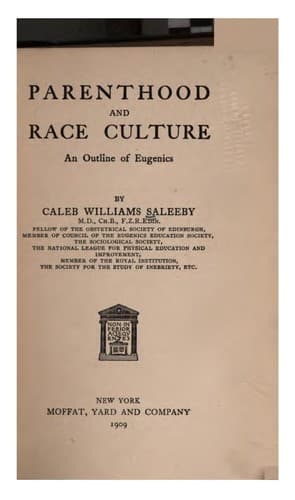
Parenthood and Race Culture: An Outline of EugenicsSaleeby, C. W. (Caleb Williams)
Philosophy
Parenthood and Race Culture: An Outline of Eugenics
Saleeby, C. W. (Caleb Williams)
Eugenics
Not less disastrous is this factitious stupidity amongst the governed.
It produces, of course, the kind of man with whom we are all familiar.
Having at great labour been taught to read, he is incapable of reading
anything but rubbish. He never thinks for himself, and if he does you
wish he had not, so inadequate is his machinery and so deplorable
the result. He believes in politicians. He is, as we have said, so
much dead weight for the reformer, whose energy is diverted from the
discovery of new truth by the need of directing the eyes of stupidity
to the old, though it shines as the sun in his strength.
Therefore, let not the reader suppose that in the advocacy of eugenics
or race-culture we have become blinded to the possibilities offered us
by reasonable education even of the very heterogeneous material offered
us by heredity.
=The limits of education--individual and racial.=--Yet it must be
maintained that, though we cannot do without education, and though
something infinitely better than we practise at present will be
necessary if the ideal of race-culture is ever to be realised, yet
education alone, however good, can never enable us to achieve our end.
It must be maintained, in the first place, that education is limited
in its powers by the inherent nature of the educated material--it is a
process of _drawing out_, and you cannot draw out what is not there:
and secondly, that its value, so far as the nature of individuals
is concerned, is confined to the individuals in question and is not
reproduced or maintained in their children. Thus education alone would
have similar material to act upon from age to age, would have to make
a fresh beginning in each generation, and its results, however good,
relatively, would still be limited and finite. We shall do well,
perhaps, to obtain and retain an adequate definition of education.
No true conception of education was possible, notwithstanding the
derivation of the word, so long as the child's mind was likened to
a piece of “pure white paper” for us to write upon: or an empty box
waiting to be filled. The _tabula rasa_ of Locke is, we now know, the
last thing in the world to resemble a child's mind. Indeed, if any
such figure be demanded, the child's mind is a piece of mosaic--made
of ancestral pieces--and education is the process of realising what is
so given. Or, if a child's mind is a portmanteau, to educate is not to
pack but to unpack it. We understand, at least, that education never
can begin at the beginning, nor anywhere near it--that, as Professor
MacCunn says in his admirable book, _The Making of Character_, “the
page of the youngest life is so far from being blank that it bears upon
it characters in comparison with which the faded ink of palæography is
as recent history.”
Public-domain text, read in full here on John Shaqi.
Reviews
Reviews
No reviews yet
Be the first to share your thoughts on this work.
Elsewhere in the archive
Join the Discussion
Join the discussion
Sign in to leave a comment or review.
Sign InorCreate an account