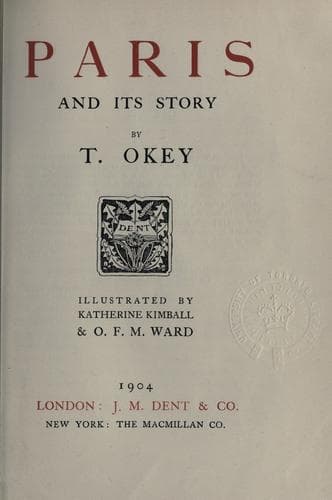
Paris (France) -- Description and travel; Paris (France) -- History
The tall, massive keep, which darkened the royal apartments in the south
wing, was the tower here meant, and after some four months' work, and an
expenditure of 2500 livres, the grim pile, with its centuries of
history, was cleared away. Small progress, however, had been made with
the restoration of the old château up to the year 1539, when the heavy
cost of preparing the west wing for the reception of the Emperor Charles
V., induced Francis to consider a plan which involved the replacement of
the whole fabric by a palace in the new Renaissance style. In 1546
Pierre Lescot was appointed architect without salary, but given the
office of almoner to the king, and made lay abbot of Clermont. Pierre
Lescot was an admirable artist, who has left us some of the finest
examples of early French Renaissance architecture in Paris. But Francis
lived only to see the great scheme begun, most of Lescot's work being
done under Henry II.
From the same anonymous writer we learn something of Parisian life in
the reign of Francis I. One day a certain Monsieur Cruche, a popular
poet and playwright, was performing moralities and novelties on a
platform in the Place Maubert, and among them a farce, "funny enough to
make half a score men die of laughter, in which the said Cruche, holding
a lantern, feigned to perceive the doings of a hen and a
salamander."[104] The amours of the king with the daughter of a
councillor of the Parlement, named Lecoq, were only too plainly
satirised. But it is ill jesting with kings. A few nights later,
Monsieur Cruche was visited by eight disguised courtiers, who treated
him to a supper in a tavern at the sign of the Castle in the Rue de la
Juiverie, and induced him to play the farce before them. When the
unhappy player came to the first scene, he was set upon by the king's
friends, stripped and beaten almost to death with thongs. They were
about to put him in a sack and throw him into the Seine, when poor
Cruche, crying piteously, discovered his priestly tonsure, and thus
escaped.
Public-domain text, read in full here on John Shaqi.
Reviews
Reviews
No reviews yet
Be the first to share your thoughts on this work.
Elsewhere in the archive
Join the Discussion
Join the discussion
Sign in to leave a comment or review.
Sign InorCreate an account