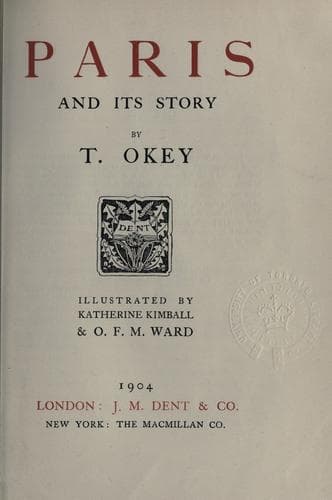
Paris (France) -- Description and travel; Paris (France) -- History
The old city gates of the Tournelle, Poissonnière (or St. Anne), St.
Martin, St. Denis, the Temple, St. Jacques, St. Victor, were demolished,
and triumphal arches, which still remain, erected to mark the sites of
the Portes St. Denis and St. Martin. Another arch, of St. Antoine, was
designed to surpass all existing or ancient monuments of the kind, and
many volumes were written concerning the language in which the
inscription should be composed, but the devouring maw of Versailles had
to be filled, and the arch was never completed. The king for whose glory
the monument was to be raised, cared so little for it, that he suffered
it to be pulled down.
[Illustration: RIVER AND PONT ROYAL.]
Many new streets[145] were made, and others widened, among them the
ill-omened Rue de la Ferronnerie. The northern ramparts were levelled
and planted with trees from the Porte St. Antoine in the east to the
Porte St. Honoré in the west, and in 1704 it was decided to continue the
planting in the south round the Faubourg St. Germain. The Place Louis le
Grand (now Vendôme), and the Place des Victoires were created; the river
embankments were renewed and extended, and a fine stone Pont Royal by J.
H. Mansard, the most beautiful of the existing bridges of Paris, was
built to replace the old wooden structure that led from the St. Germain
quarter to the Tuileries. This in its turn had replaced a ferry (_bac_)
established by the Guild of Ferrymen, to transport the stone needed for
the construction of the Tuileries, and the street which leads to the
bridge still bears the name of the Rue du Bac. The Isle Louviers was
acquired by the Ville, and the evil-smelling tanneries and dye-houses
that disfigured the banks of the Seine between the Grève and the
Châtelet were cleared away; many new fountains embellished the city, and
ten new pumps increased the supply of water. The poorer quarters were,
however, little changed from their old insanitary condition. A few years
later Rousseau, fresh from Turin, was profoundly disappointed by the
streets of Paris as he entered the city by the Faubourg St. Marceau. "I
had imagined," he writes, "a city as fair as it was great, and of a most
imposing aspect, whose superb streets were lined with palaces of marble
and of gold. I saw only filthy, evil-smelling, mean streets, ugly houses
black with dirt, a general air of uncleanness and of poverty, beggars
and carters, old clothes shops and tisane sellers."
Public-domain text, read in full here on John Shaqi.
Reviews
Reviews
No reviews yet
Be the first to share your thoughts on this work.
Elsewhere in the archive
Join the Discussion
Join the discussion
Sign in to leave a comment or review.
Sign InorCreate an account