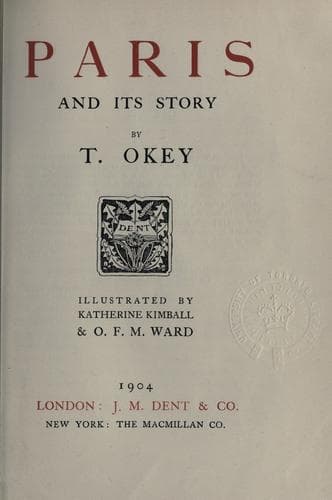
Paris (France) -- Description and travel; Paris (France) -- History
In 1768 the poor abused, injured and neglected queen, Marie Leczynski
died. The court went from bad to worse: void of all dignity, all gaiety,
all wit and all elegance, it drifted to its doom. Six years passed, and
Louis was smitten by confluent small-pox and a few poor women were left
to perform the last offices on the mass of pestiferous corruption that
once was the fifteenth Louis of France.[149] None could be found to
embalm the corpse, and spirits of wine were poured into the coffin
which was carried to St. Denis without pomp and amid the half-suppressed
curses of the people. Before the breath had left the body, a noise as of
thunder was heard approaching the chamber of the Dauphin and Marie
Antoinette: it was the sound of the courtiers hastening to grovel before
the new king and queen. Warned that they had now inherited the awful
legacy of the French monarchy, they flung themselves in tears on their
knees, and exclaimed--"O God, guide and protect us! We are too young to
govern."
[Illustration: PLACE DU CHÂTELET AND TOUR ST. JACQUES.]
The degradation of the monarchy during the reign is reflected in the
condition of the royal palace in the capital. Henry IV.'s great scheme,
which Louis XIII. had inherited and furthered, included a colossal
equestrian statue, which was to stand on a rocky pedestal in the centre
of a new Place, before the east front of the Louvre, but the regency
revoked the scheme, and for thirty years nothing was done. It had even
been proposed under the ministry of Cardinal Fleury to pull the whole
structure down and sell the site. The neglect of the palace during these
years is almost incredible. Perrault's fine façade was hidden by the
half-demolished walls of the Hôtels de Longueville, de Villequier, and
de Bourbon. The east wing itself was unroofed on the quadrangle side and
covered with rotting boarding. Perrault's columns on the outer façade
were unchannelled, the capitals unfinished, the portal unsculptured, and
the post-office stabled its horses along the whole of the wing from the
middle entrance to the north angle. The royal apartments of Anne of
Austria in the Petite Galerie were used as stables; so, too, were the
halls where now is housed the collection of Renaissance sculpture. The
Infanta's garden was a yard where grooms exercised their horses: a
colony of poor artists and court attendants were lodged in the upper
floors, and over most of the great halls entresols were constructed to
increase this kind of accommodation. The building was described as a
huge caravanserai, where each one lodged and worked as he chose, and
over which might have been placed the legend, "_Ici on loge à pied et à
cheval_." Worse still, an army of squatters, ne'er-do-weels, bankrupts
and defaulting debtors took refuge in the wooden sheds left by the
contractors, or built others--a miserable gangrene of hovels--against
the east façade. Perrault's base had been concealed by rubbish and
apparently forgotten.
Public-domain text, read in full here on John Shaqi.
Reviews
Reviews
No reviews yet
Be the first to share your thoughts on this work.
Elsewhere in the archive
Join the Discussion
Join the discussion
Sign in to leave a comment or review.
Sign InorCreate an account