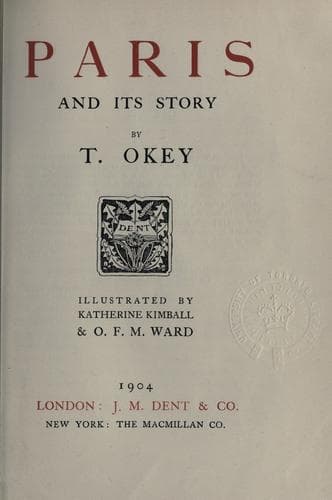
Paris (France) -- Description and travel; Paris (France) -- History
Half a century had elapsed since that meal in the peasant's house and
the royal colloquy with the villager in the forest of Senard, when the
Nemesis that holds sleepless vigil over the affairs of men stirred her
pinions and, like a strong angel with glittering sword, prepared to
avenge the wrongs of a people whose rulers had outraged every law, human
and divine, by which human society is held together. King, nobles, and
prelates had a supreme and an awful choice. They might have led and
controlled the Revolution: they chose to oppose it, and were broken into
shivers as a potter's vessel.
After the memorable cannonade at Valmy, a knot of defeated German
officers gathered in rain and wind moodily around the circle where they
durst not kindle the usual camp-fire. In the morning the army had talked
of nothing but spitting and devouring the whole French nation: in the
evening everyone went about alone; nobody looked at his neighbour, or if
he did, it was but to curse and swear. "At last," says Goethe, "I was
called upon to speak, for I had been wont to enliven and amuse the troop
with short sayings. This time I said, 'From this day forth, and from
this place, a new era begins in the history of the world and you can all
say that you were present at its birth.'" This is not the place to write
the story of the French Revolution. Those who would read the tremendous
drama may be referred to the pages of Carlyle. As a formal history, that
work of transcendent genius may be open to criticism. Indeed to the
present writer the magnificent and solemn prosody seems to partake of
the nature of a Greek chorus--the comment of an idealised spectator,
assuming that the hearer has the drama unfolding before his eyes. Recent
researches have supplemented and modified our knowledge. It is no longer
possible to accept the more revolting representations of the misery[156]
of the French peasantry as true of the whole of France, for France
before the Revolution was an assemblage of many provinces of varying
social conditions, subjected to varying administrative laws. Nor can we
accept Carlyle's portraiture of Robespierre as history, after Louis
Blanc's great work. So far from Robespierre having been the bloodthirsty
protagonist of the later Terror, it was precisely his determination to
make an end of the more savage excesses of the extreme Terrorists and
to chastise their more furious pro-consuls, such as Carrier and Fouché,
that brought about his ruin. It was men like Collot d'Herbois, Billaud
Varenne and Barrère, the bloodiest of the Terrorists, who, to save their
own skins, united to cast the odium of the later excesses on
Robespierre, and to overthrow him. During the forty-five days that
preceded his withdrawal from the sittings of the Committee of Public
Safety, 577 persons were guillotined: during the forty-five days that
succeeded, 1285 went to their doom. Of the twelve decrees that have been
discovered signed by Robespierre during the four last decades, only one
Public-domain text, read in full here on John Shaqi.
Reviews
Reviews
No reviews yet
Be the first to share your thoughts on this work.
Elsewhere in the archive
Join the Discussion
Join the discussion
Sign in to leave a comment or review.
Sign InorCreate an account