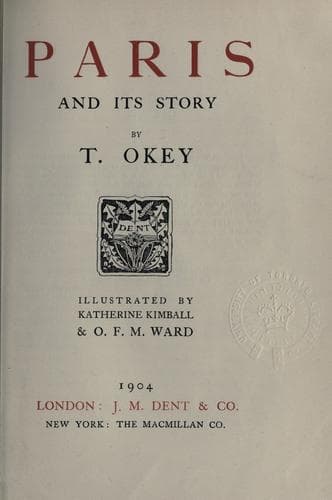
Paris (France) -- Description and travel; Paris (France) -- History
There, on Wednesday, 16th January 1793, began the solemn judgment of
Louis XVI. by 721 representatives of the people of France. The sitting
opened at ten o'clock in the morning, but not till eight in the evening
did the procession of deputies begin, as the roll was called, to ascend
the tribune, and utter their word of doom. All that long winter's night,
and all the ensuing short winter's day, the fate of a king trembled in
the balance as the judgment, death--banishment: banishment--death, with
awful alternation echoed through the hall. Amid the speeches of the
deputies was heard the chatter of fashionable women in the boxes,
pricking with pins on cards the votes for and against death, and eating
ices and oranges brought to them by friendly deputies. Above, in the
public tribunes, sat women of the people, greeting the words of the
deputies with coarse gibes. Betting went on outside. At every entrance
cries hoarse and shrill were heard of hawkers selling "The Trial of
Charles I." Time-serving Philip Egalité, Duke of Orleans, voted _la
mort_, but failed to save his skin. An Englishman was there--Thomas
Paine, author of the _Rights of Man_ and deputy for Calais. His voice
was raised for clemency, for temporary detention, and banishment after
the peace. "My vote is that of Paine," cried a member, "his authority is
final for me." One deputy was carried from a sick-bed to cast his vote
in the scale of mercy; others slumbering on the benches were awakened
and gave their votes of death between two yawns. At length, by eight
o'clock on the evening of the 17th, exactly twenty-four hours after the
voting began, the President rose to read the result. "A silence most
august and terrible reigns in the Assembly as President Vergniaud rises
and pronounces the sentence 'Death' in the name of the French nation."
The details of the voting as given in the _Journal de Perlet_, 18th
January 1793, are as follows: "Of the 745 members one had died, six were
sick, two absent without cause, eleven absent on commission, four
abstained from voting. The absolute majority was therefore 361. Three
hundred and sixty-six voted for death, three hundred and nineteen for
detention and banishment, two for the galleys, twenty-four for death
with various reservations, eight for death with stay of execution until
after the peace, two for delay with power of commutation." Three
Protestant ministers and eighteen Catholic priests voted for death.
Louis' defenders were there and asked to be heard: they were admitted to
the honours of the sitting. At eleven o'clock the weary business of
thirty-seven hours was ended, only, however, to be resumed the next
morning, for yet another vote must decide between delay or summary
execution. Again the voice of Paine was heard pleading for mercy, but
without avail. At three o'clock on Sunday morning the final voting was
over. Six hundred and ninety members were present, of whom three hundred
and eighty voted for death within twenty-four hours.
Public-domain text, read in full here on John Shaqi.
Reviews
Reviews
No reviews yet
Be the first to share your thoughts on this work.
Elsewhere in the archive
Join the Discussion
Join the discussion
Sign in to leave a comment or review.
Sign InorCreate an account