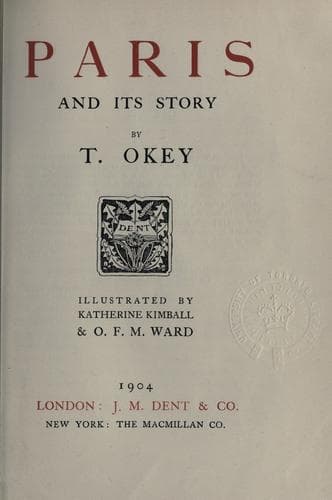
Paris (France) -- Description and travel; Paris (France) -- History
The new ideas were none the less revolutionary of social life. The
salon, that eminently French institution, soon felt their power. The
charming irresponsible gaiety and frivolity of the old _régime_ gave
place to more serious preoccupation with political movements. The fusing
power of Rousseau's genius had melted all hearts; the solvent wit of
Voltaire and the precise science of the Encyclopedists were a potent
force even among the courtiers themselves. The centre of social life
shifted from Versailles to Paris and the salons gained what the court
lost. Fine ladies had the latest pamphlet of Siéyès read to them at
their toilette, and maids caught up the new phrases from their
mistresses' lips. Did a young gallant enter a salon excusing himself for
being late by saying, "I have just been proposing a motion at the club,"
every fair eye sparkled with interest. A deputy was a social lion, and a
box for the National Assembly exchanged for one at the opera at a
premium of six livres. Speeches were rehearsed at the salons and action
determined. Chief of the hostesses was Madame[165] Necker: at her
crowded receptions might be seen Abbé Siéyès, the architect of
Constitutions; Condorcet, the philosopher; Talleyrand, the patriotic
bishop; Madame de Stäel, with her strong, coarse face and masculine
voice and gestures. More intimate were the Tuesday suppers at which a
dozen chosen guests held earnest communion. Madame de Beauharnais was
noted for her excellent table, and her Tuesday and Thursday dinners: at
her rooms the masters of literature and music had been wont to meet. Now
came Buffon the naturalist; Bailly of Tennis Court oath fame; Clootz,
the friend of humanity. The widow of Helvetius, with her many memories
of Franklin, welcomed Volney, author of the _Ruins of Empires_, and
Chamfort, the candid critic of Academicians. At the salon of Madame
Pancroute, Barrère, the glib orator of the Revolution, was the chief
figure.
Julie Talma was famed for her literary and artistic circle. Here Marie
Joseph Chenier, the revolutionary dramatic poet of the Comédie
Française, declaimed his couplets. Here came Vergniaud, the eloquent
chief of the ill-fated Gironde; Greuze, the painter; Roland, the stern
and minatory minister, who spoke bitter words, composed by his wife, to
the king; Lavoisier, the chemist, who begged that the axe might be
stayed while he completed some experiments, and was told that the
Republic had no need of chemists. Madame du Deffand, whose hotel in the
Rue des Quatre Fils still exists, welcomed Voltaire, D'Alembert,
Montesquieu and the Encyclopedists.
Public-domain text, read in full here on John Shaqi.
Reviews
Reviews
No reviews yet
Be the first to share your thoughts on this work.
Elsewhere in the archive
Join the Discussion
Join the discussion
Sign in to leave a comment or review.
Sign InorCreate an account