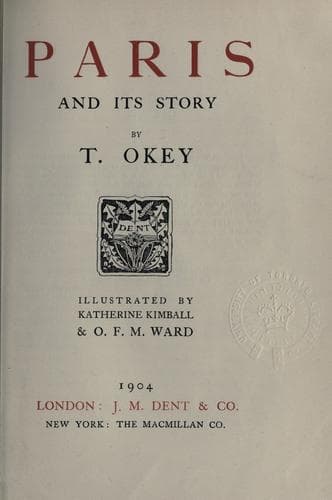
Paris (France) -- Description and travel; Paris (France) -- History
It is not within the scope of the present work to deal with the later
annals of France. Superficial students of her modern history have freely
charged her with political irresponsibility and fickleness; no charge
could be less warranted by facts. For a thousand years her people were
loyal and faithful subjects of a monarchy, and endured for a century and
a half an infliction of misgovernment, oppression and grinding taxation
such as probably no other European people would have tolerated. With
touching fidelity and indomitable steadfastness the French people have
cherished the principles of the Great Revolution, in whose name they
swept the shams and wrongs of the _ancien régime_ away. There is a
profounder truth than perhaps Alphonse Karr imagined in his famous
epigram, _Plus ça change plus c'est la même chose_. Every political
upheaval of the nineteenth century in Paris has been at bottom an effort
to realise the revolutionary ideals of political freedom and social
equality in the face of external violence or internal corruption and
treachery. Twice the hated Bourbons were re-imposed on the people of
Paris by the bayonets of the foreigner; twice they rose and chased them
away. A compromise followed--that of a citizen king, Louis Philippe of
Orleans, once a Jacobin doorkeeper and a soldier of the Revolution, who
had fought valiantly at Valmy and Jemappes. But he too identified
himself with reactionary ministers, and became a fugitive to England,
the bourne of deposed kings. The Second Republic which followed grew
distrustful of the people and disfranchised at one stroke 3,000,000
citizens: one of the causes of the success of the _coup d'état_ of
Napoleon III. was an astute edict which restored universal suffrage.
During the negation of political rectitude and decency which
characterised the period of the Second Empire a little band of
Republicans refused to bow the knee to the new pinchbeck Cæsar, and,
inspired by Victor Hugo, their fiery poet and seer, whose _Châtiments_
have the passionate intensity of an Isaiah, braved exile, poverty,
calumny and flattery. They "stooped into a dark, tremendous sea of
doubt, pressed God's lamp to their breasts and emerged" to witness a sad
and bitter day of reckoning, when the corruption and vice of the Second
Empire were swallowed up in shame and disaster at Sedan. The Third
Republic, with admirable energy and patriotism, rose to save the
self-respect of France. The first and Imperial war, up to Sedan, was
over in a month; the second national and popular war endured for five
months.
[Illustration: THE LOUVRE--EASTERN ENTRANCE.]
Public-domain text, read in full here on John Shaqi.
Reviews
Reviews
No reviews yet
Be the first to share your thoughts on this work.
Elsewhere in the archive
Join the Discussion
Join the discussion
Sign in to leave a comment or review.
Sign InorCreate an account