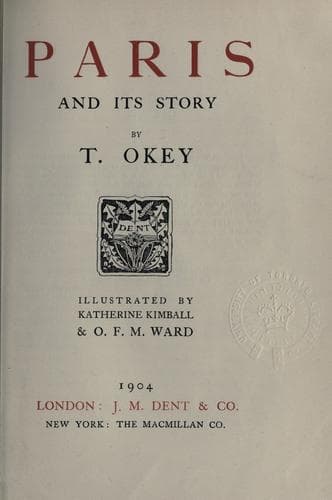
Paris (France) -- Description and travel; Paris (France) -- History
Under the citizen king, Napoleon's Arch of Triumph of the Etoile was
completed, and the Columns of Luxor, on the Place de la Concorde, and of
July on the Place de la Bastille, were raised. It was the period of the
admirable architectural restorations of Viollet le Duc. The great
architect has described how his passion for Gothic was stirred when,
taken as a boy to Notre Dame, the rose window of the south seized upon
his imagination. While gazing at it the organ began to play, and he
thought that the music came from the window--the shrill, high notes from
the light colours, the solemn, bass notes from the dark and more subdued
hues. It was a reverent and admiring spirit such as this which inspired
the famous architect's loving treatment of the Gothic restoration in
Paris and all over France. To him more than to any other artist we owe
the preservation of such masterpieces as Notre Dame and the Sainte
Chapelle.
But the great changes which have made modern Paris were effected under
the Second Empire. In 1854, when the Haussemannisation of the city
began, the Paris of the First Empire and of the Restoration remained
essentially unaltered. It was a city of a few grand streets and of many
mean ones. Pavements were still rare, and drainage was imperfect. In a
few years the whole aspect was changed. Twenty-two new boulevards and
avenues were created. Streets of appalling uniformity and directness
were ploughed through Paris in all directions. "Nothing is more brutal
than a straight line," says Victor Hugo, and there is little of interest
in the monotonous miles of dreary coincidence which constitute the
architectural legacy of the Second Empire.
[Illustration: RUE DROUET AND SACRÉ COEUR.]
[Illustration: HOTEL DE VILLE FROM RIVER.]
The sad task of the Third Republic has been to heal the wounds and
cover up the destruction wrought by the Civil War of 1871. The chief
architectural creations of the Third Republic are the Hôtel de Ville,
the new Sorbonne, the Trocadero, and the completion of the magnificent
and colossal temple, rich with precious marble and stone of every kind,
which, at a cost of £10,000,000 sterling, has been raised to the Muses
at the end of the Avenue de l'Opéra. The Church, too, has lavished her
millions on the mighty basilica of the Sacré Coeur, which dominates
Paris from the heights of Montmartre. But some of the glory of past ages
remains hidden away in corners of the city; some has been recovered from
the vandalism of iconoclastic eighteenth-century architects, canons,
revolutionists and nineteenth-century prefects.
Let us now wander awhile about the great city and refresh our memories
of her dramatic past by beholding somewhat of the interest and beauty
which have been preserved to us; for "to be in Paris itself, amid the
full, delightful fragrance of those dainty visible things which
Huguenots despised--that, surely, were the sum of good fortune!"
CHAPTER XIX
Public-domain text, read in full here on John Shaqi.
Reviews
Reviews
No reviews yet
Be the first to share your thoughts on this work.
Elsewhere in the archive
Join the Discussion
Join the discussion
Sign in to leave a comment or review.
Sign InorCreate an account