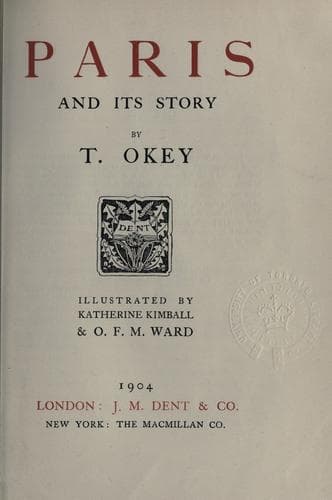
Paris (France) -- Description and travel; Paris (France) -- History
West of the Boulevard St. Michel are the fine modern buildings of the
Ecole de Médecine, which, from 1369 to the times of Louis XV., was
situated further eastwards in the Rue de la Bûcherie, where (No. 13)
some remains of the old hall of the Faculty may yet be seen. It was here
that an anatomical and surgical theatre was built in 1617. The old
Franciscan refectory (No. 15 Rue de l'Ecole de Médecine) is all that
remains of the great monastery of the Cordeliers. Here the body of Marat
was laid on an altar, after his assassination by Charlotte Corday in a
house on whose site his statue stands. The refectory is now used as a
pathological museum for medical students. The famous revolutionary club
of the Cordeliers, where the gentler rhetoric of Camille Desmoulins vied
with the thunderous declamation of Danton to stir Republican fervour,
met in the Hall of Theology. At No. 5 are some remains of the school of
surgery, or Guild of St. Cosimo and St. Damian, founded by St. Louis;
adjacent stood the church of St. Cosimo (St. Cosme), famous for the
fiery zeal of its _curé_ during the times of the League.
The surgeons were by their charter compelled to give professional
assistance to the poor every Monday, and in 1561 the _curé_ and
churchwardens of St. Cosme obtained a papal bull authorising them to
erect in their church a suitable consulting hall for the accommodation
of poor patients. In 1694 the surgeons built an anatomical theatre of
their own at St. Cosme, which was enlarged in 1710. The buildings are
now used as a school of decorative art. The magnificent Franciscan
church, where many a queen of France lay buried, stood on the site of
the present Place de l'Ecole de Médecine.
South of these is the Luxembourg Palace, whose charming Renaissance
gardens, unhappily, owing to the erection of the Observatory in 1672,
reduced by more than one-third of their former extent, are the delight
of the Parisians of the south bank of the Seine. The old Orangery,
restored and enlarged, is used as a public museum of contemporary French
art, chiefly painting and sculpture. Here are exhibited the works of
modern artists which have been deemed worthy of acquisition by the
State. They display great talent and technical skill, but the visitor
will leave, impressed by few works of great distinction. The English
traveller will, however, be envious of a collection whose catholicity
embraces examples of the work of two great modern masters, Londoners by
option--Legros and Whistler. Any impression of modern French painting
that may be left on the mind of the visitor by an inspection of the
examples hung in the Luxembourg should however be supplemented and
corrected by a visit to the decorative works in the great public
edifices, such as the Hôtel de Ville, the Sorbonne, the Panthéon, and
the churches of Paris.
Public-domain text, read in full here on John Shaqi.
Reviews
Reviews
No reviews yet
Be the first to share your thoughts on this work.
Elsewhere in the archive
Join the Discussion
Join the discussion
Sign in to leave a comment or review.
Sign InorCreate an account