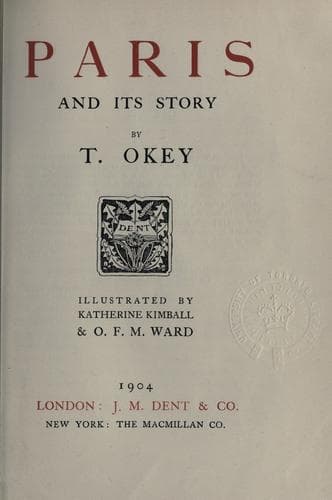
Paris (France) -- Description and travel; Paris (France) -- History
To the east of the hotel stands the church of St. Gervais, whose façade
by Debrosse (1617) "is regarded," says Félibien (1725), "as a
masterpiece of art by the best architectural authorities" ("_les plus
intelligens en architecture_"). The church, which has been several times
rebuilt, occupies the site of the old sixth-century building, near which
stood the elm tree where suitors waited for justice to be done by the
early kings. "_Attendre sous l'orme_" ("To wait under the elm") is still
a proverbial expression for waiting till Doomsday. To the east of the
Rue St. Martin is the quarter of the Marais (marsh) at whose eastern
limit a group of street names recalls the royal palace-city of St. Paul.
At the south of the Rue du Figuier, on the Place de l'Ave Maria, stands
the Hôtel of the Archbishops of Sens, and near by, in the Passage
Charlemagne, is the Hôtel of the royal Provost of Paris. As we cross the
Rue St. Antoine to the old Place Royale (des Vosges), we may note at No.
21 the Hôtel de Mayenne--where the chamber still exists in which the
leaders of the League met and decided to assassinate Henry III.--and at
No. 62, the Hôtel de Sully, where Henry the Fourth's great minister
and, later, Turgot dwelt. The Place Royale occupies the site of the
palace of the Tournelles built for the Duke of Bedford during the
English occupation, near which Henry II. lost his life in the fatal
tournament. The palace became hateful to Catherine de' Medici, and she
had it demolished. The site was subsequently used as a horse market,
and there three mignons of Henry III. fought their bloody duel with
three bullies of the Duke of Guise. The architecture of Henry IV. Place
is little changed; the king's and queen's pavilions stood south and
north; Richelieu occupied the present No. 21, and at No. 6 dwelt Marshal
Lavardin, who was sitting in the coach when his royal master, Henry IV.,
was stabbed. Later this house was occupied by Victor Hugo, and is now
maintained as a museum of much interest to lovers of the darling poet of
nineteenth-century Paris. A little to the west, in the Rue des Francs
Bourgeois, is the Hôtel Carnarvalet, built in 1544 by Jean Bullant, the
architect of the Tuileries, to the design of Pierre Lescot. Jean Goujon
carved, among other decorative works, the fine reliefs of the four
Seasons in the quadrangle where now stands a bronze statue of Louis XIV.
by Coyzevox, brought from the old Hôtel de Ville. In this noble
Renaissance mansion, enlarged by F. Mansard and others, lived for twenty
years Madame de Sévigné, queen of letter writers, and her
_Carnarvalette_, as she lovingly called it, is now the civic museum of
Paris, devoted to objects illustrating the history of the city. It is
especially rich in exhibits bearing on the Great Revolution. Passing
along the Rue des Francs Bourgeois we may note (No. 38) an old
inscription which marks the scene of the assassination of the Duke of
Orleans by Jean sans Peur.
Public-domain text, read in full here on John Shaqi.
Reviews
Reviews
No reviews yet
Be the first to share your thoughts on this work.
Elsewhere in the archive
Join the Discussion
Join the discussion
Sign in to leave a comment or review.
Sign InorCreate an account