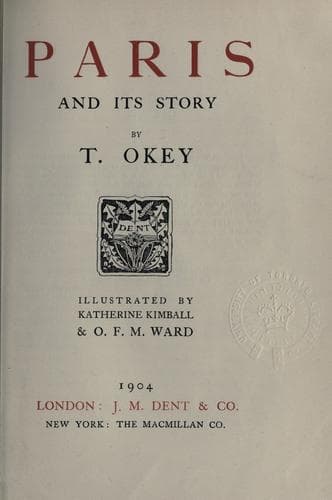
Paris (France) -- Description and travel; Paris (France) -- History
At the south angle of the Rue Montmartre the majestic transitional
church of St. Eustache towers over the Halles. We descend the Rue
Vauvilliers, formerly of the Four (oven) St. Honoré, in which two of the
houses still display old painted signs: others retain their quaint
appellations--The Sheep's Trotter, The Golden Sun, The Cat and Ball.
Turning westward by the Rue St. Honoré, we shall find at the corner of
the Rue de l'Arbre Sec the fine fountain of the Croix du Trahoir erected
in the reign of Francis I. and rebuilt by Soufflot in 1775: here
tradition places the cruel death of Queen Brunehaut. Lower down, where
the street intersects the Rue de Rivoli, an inscription on the corner
house to the left marks the site of the Hôtel de Montbazan, where
Coligny was assassinated, and yet lower down the Rue de l'Arbre Sec we
note the Hôtel des Mousquetaires, the dwelling of the famous D'Artagnan
of Dumas' _Trois Mousquetaires_, opposite the apse of the church of St.
Germain l'Auxerrois. After examining the interior of the church,
especially the beautiful fifteenth-century Chambre des Archives, and the
porch of the same date, we are brought face to face with the principal
entrance to the Louvre.
[Illustration: NEAR THE PONT NEUF.]
No other edifice in the world forms so vast a treasure house of rich and
varied works of art as the great Palace of the Louvre whose growth we
have traced in our story. The nucleus of the gallery of paintings was
formed by Francis I. and the Renaissance princes at the palace of
Fontainebleau, where the canvases at the beginning of the seventeenth
century had reached nearly 200. Colbert, during the reign of Louis XIV.
by the purchase of the Mazarin and other collections, added 647
paintings and nearly 6000 drawings in ten years. In 1681 the Cabinet du
Roi, for so the collection of royal pictures was called, was transferred
to the Louvre. They soon, however, followed their owner to Versailles,
but some hundred were subsequently returned to Paris, where they might
be inspected at the Luxembourg Palace by the public on Wednesdays and
Saturdays. In 1709 Bailly, the keeper of the king's cabinet, took an
inventory of the paintings and they were found to number 2376. In 1757
all were again returned to Versailles, and it was not until 1793, when
the National Convention, on Barrère's motion, took the matter in hand,
that they were restored to the Parisians and, together with the works of
art removed from the suppressed churches and monasteries, formed the
famous picture gallery of the Louvre, which was formally opened to the
public on the first anniversary of the memorable 10th of August.
Napoleon's spoils from Italian and other European galleries, which
almost choked the Louvre during his reign, were reduced in 1815 by the
return of 5233 works of art to their original owners, under English
supervision. During the removal of the pictures British sentries were
stationed along the galleries, and British soldiers stood under arms on
Public-domain text, read in full here on John Shaqi.
Reviews
Reviews
No reviews yet
Be the first to share your thoughts on this work.
Elsewhere in the archive
Join the Discussion
Join the discussion
Sign in to leave a comment or review.
Sign InorCreate an account