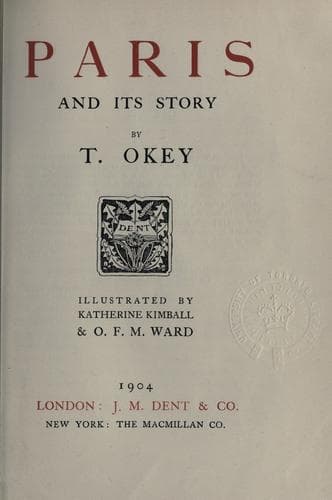
Paris (France) -- Description and travel; Paris (France) -- History
The last edition (1903) of the _Summary Catalogue_ of the pictures in
the Louvre contains the titles of 2984 works, apart from decorative
ceiling and mural paintings. The visitor must therefore needs make
choice of his own favourite schools or masters, for, if he were to
devote but one minute to a cursory examination of each exhibit,
twenty-five visits of two hours each would be needed to view the whole
collection. The pictures bear evidence of the period during which they
were amassed, for they are rich in examples of the later Italian and
Netherland schools and relatively poor in those of the pre-Raphaelite
masters. But among the latter is Fra Angelico's Coronation of the
Virgin, which Vasari declared must have been painted by the hand of one
of the blessed spirits or angels represented in the picture, so
unspeakably sweet and delightful were their forms, so gentle and
delicate their mien, so glorious their colouration. "Even so," he adds,
"and not otherwise, must they be in heaven, and never do I gaze on this
picture without discovering fresh beauties, and never do I withdraw my
eyes from it sated with seeing." Every phase in Raphael's development,
from the Peruginesque to the Roman periods, may be studied in the
Louvre. No gallery in Europe--not excepting the Accademia of Venice--can
approach the Louvre in the wealth of its Titians, and the same might
almost be said of its Veroneses. It contains the most famous portrait in
the world--Da Vinci's Monna Lisa--and some exquisite examples of Luini's
fresco and easel works. Among the rich collections of Tuscan and
other Italian masters, we may mention two charming frescoes by
Botticelli. In no gallery outside Spain are the Spanish artists,
especially Murillo, so well represented, and magnificent examples of the
later Flemings, Rubens and Van Dyck, adorn its walls. Among the latter
master's works is the Charles I. (No. 1967), bought for the boudoir of
Madame Dubarry by Louis XV. on the fiction that it was a family picture,
since the page holding the horse was named Barry. Michelet, in his
_History of the Revolution_, says that he never visited the Louvre
without staying to muse before this famous historic canvas.[169] Among
the later Dutch masters, most of whom are adequately represented, are
some masterpieces by Rembrandt; of the Germans, Holbein is seen at his
best in some superb portraits.
Public-domain text, read in full here on John Shaqi.
Reviews
Reviews
No reviews yet
Be the first to share your thoughts on this work.
Elsewhere in the archive
Join the Discussion
Join the discussion
Sign in to leave a comment or review.
Sign InorCreate an account