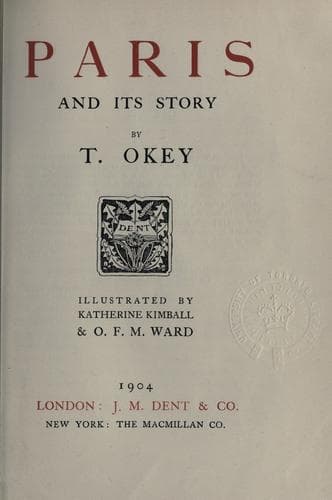
Paris (France) -- Description and travel; Paris (France) -- History
A two-fold study of absorbing interest to the artistic mind may be
prosecuted in the Louvre--the development of the modern Romantic school
of French painters from Gericault's famous Raft of the Medusa, painted
in 1819, through the works of Delacroix and Delaroche; and the
revival of landscape painting, under the stimulus of the English artists
Bonnington and Constable, by Rousseau (1812-1867), the all-father of the
modern French landscape school, and the little band of enthusiasts that
grouped themselves around him at Barbizon. Corot, Daubigny, Diaz, Troyon
and the grand and solemn Millet, once despised and rejected of men, have
now won fame and appreciation. No princely patronage shone upon them nor
smoothed their path; they wrought out the beauty of their souls under
the hard discipline of poverty and in loving and awful communion with
nature. They have revealed to the modern world new tones of colour in
the air and the forest and the plain, and a new sense of the pathos and
beauty in simple lives and common things.
The artistic treasures we have thus briefly and summarily reviewed form
but a part of the inestimable possessions of the Louvre. Collections of
drawings; ivories; reliquaries and sanctuary vessels; pottery;
jewellery; furniture (among which is the famous _bureau du roi_, the
most wonderful piece of cabinet work in Europe); bronzes; Greek,
Egyptian, Assyrian, Chaldean and Persian antiquities (including the
unique and magnificent frieze of the archers from the palace of Darius
I.), all are crowded with objects of interest and beauty, even to the
inexpert visitor.
Of the gorgeous palace of the Tuileries, with its inharmonious but
picturesque façade, stretching across the western limit of the Louvre
from the Pavilion de Flore to the Pavilion de Marsan, not one stone is
left on another. We remember it after its fiery purgation by the Commune
in 1871, a gaunt shell blackened and ruined, fitting emblem of the wreck
which the enthroned wantonness and corruption of the Second Empire had
made of France.
[Illustration: GRACE BEFORE MEAT.
CHARDIN.]
[Illustration: MADAME RECAMIER.
DAVID.]
Public-domain text, read in full here on John Shaqi.
Reviews
Reviews
No reviews yet
Be the first to share your thoughts on this work.
Elsewhere in the archive
Join the Discussion
Join the discussion
Sign in to leave a comment or review.
Sign InorCreate an account