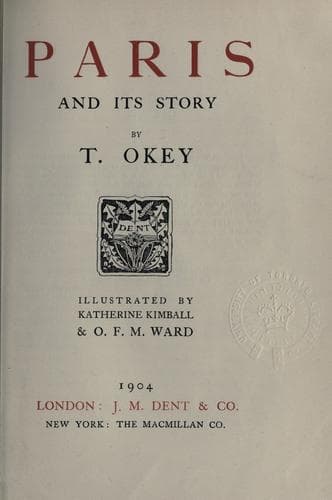
Paris (France) -- Description and travel; Paris (France) -- History
The Place Louis XV (now de la Concorde), with its setting of pavilions
adorned with groups of statuary representing the chief cities of France,
was created by Gabriel in 1763-1772 on the site of a dreary, marshy
waste used as a depot for marble. The Place was adorned in 1763 with an
equestrian statue of Louis XV., elevated on a pedestal which was
decorated at the corners by statues of the cardinal virtues. Mordant
couplets, two of which we transcribe, affixed on the base, soon
expressed the judgment of the Parisians:--
"_O la belle statue! O le beau piédestal!_
_Les vertus sont à pied, le vice est à cheval._"[174]
"_Il est ici come à Versailles_
_Il est sans coeur et sans entrailles._"[175]
After the fall of the monarchy the Place was known as the Place de la
Revolution, and in 1792, Louis XV. with the other royal simulacra in
bronze having been forged into the cannon that thundered against the
allied kings of Europe, a plaster statue of Liberty was erected, at
whose side the guillotine mowed down king and queen, revolutionist and
aristocrat in one bloody harvest of death, ensanguining the very figure
of the goddess herself, who looked on with cold and impassive mien. She
too fell, and in her place stood a _fascis_ of eighty-three spears,
symbolising the unity of the eighty-three departments of France. In 1795
the Directory changed the name to Place de la Concorde, and again in
1799 a seated statue of Liberty holding a globe was set up. In the
hollow globe a pair of wild doves built their nest--a futile augury, for
in 1801 Liberty II. was broken in pieces, and the model for a tall
granite column erected in its place by Napoleon I. One year passed and
this too disappeared. After the Restoration, among the other inanities
came, in 1816, a second statue of Louis XV., and the Place resumed its
original name. Ten years later an expiatory monument to Louis XVI. was
begun, only to be swept away with other Bourbon lumber by the July
Revolution of 1830. At length the famous obelisk from Luxor, after many
vicissitudes, was elevated in 1836 where it now stands.
[Illustration: LANDSCAPE.
COROT.]
Public-domain text, read in full here on John Shaqi.
Reviews
Reviews
No reviews yet
Be the first to share your thoughts on this work.
Elsewhere in the archive
Join the Discussion
Join the discussion
Sign in to leave a comment or review.
Sign InorCreate an account