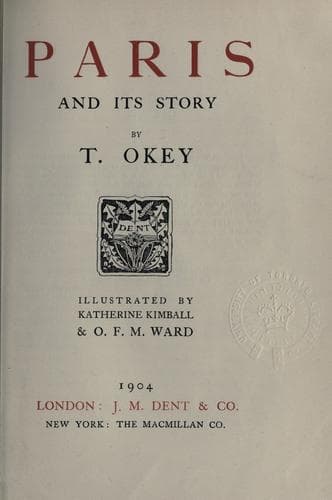
Paris (France) -- Description and travel; Paris (France) -- History
[23] The palace in the Cité, where now stands the Palais de Justice.
[24] Roads in the Arrondissement of Amiens and Mondidier in Picardy
are still known as Chaussées Brunehautes.
[25] The works of art traditionally ascribed to St. Eloy are many. He
is reported to have made a golden throne set with stones (or rather
two thrones, for he used his material so honestly and economically).
He was made master of the mint and thirteen pieces of money are known
which bear his name. He decorated the tombs of St. Martin and St.
Denis, and constructed reliquaries for St. Germain, Notre Dame, and
other churches.
[26] Five of them died between the ages of eighteen and twenty-six.
[27] It was during this struggle that St. Leger, bishop of Autun,
whose name is dear to English sportsmen, one of the most popular of
saints in his time, was imprisoned, blinded and subsequently beheaded
by Ebrion's orders in 678.
[28] The term Cité (_civitas_) was given to the old Roman part of many
French towns.
[29] The Carlovingians had been careful to abolish the office of mayor
of the palace.
[30] St. Pierre was subsequently enriched by the possession of the
body of St. Maur, brought thither in the Norman troubles by fugitive
monks from Anjou, and the monastery is better known to history under
the name of St. Maur des Fossés. The entrails of our own Henry V. were
buried there. Rabelais, before its secularisation, was one of its
canons, and Catherine de Medicis once possessed a château on its site.
Monastery and château no longer exist.
[31] The villa of those days was a vast domain, part dwelling, part
farm, part game preserve.
[32] The remains of the great Viking's castle are still shown at
Aalesund, in Norway.
[33] When Allan Barbetorte, after the recovery of Nantes, went to give
thanks to God in the cathedral, he was compelled to cut his way, sword
in hand, through thorns and briers.
[34] It must be admitted, however, that the poet's uncouth diction is
anything but Virgilian.
[35] Abbo's favourite epithet. They were without a head, for they knew
not Christ, the Head of Mankind.
[36] In the Middle Ages and down to 1761 Montfaucon had a sinister
reputation. There stood the gallows of Paris, a great stone gibbet
with its three rows of chains, near the old Barrière du Combat, where
the present Rue de la Grange aux Belles abuts on the Boulevard de la
Villette.
[37] William the Conqueror was also known as William the Builder.
[38] The surname Capet is said to have originated in the _capet_
or hood of the abbot's mantle which Hugh wore as lay abbot of St.
Martin's, having laid aside the crown after his coronation.
[39] Carducci. _In una Chiesa gotica._
[40] A dramatic representation of the delivery of the papal bull,
painted by Jean Paul Laurens, hangs in the museum of the Luxembourg.
Public-domain text, read in full here on John Shaqi.
Reviews
Reviews
No reviews yet
Be the first to share your thoughts on this work.
Elsewhere in the archive
Join the Discussion
Join the discussion
Sign in to leave a comment or review.
Sign InorCreate an account