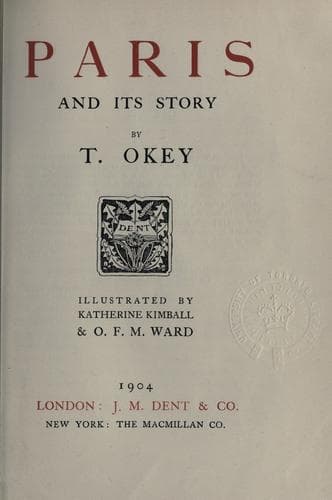
Paris (France) -- Description and travel; Paris (France) -- History
[131] The Rue Poulletier marks the line of the old channel between the
islands.
[132] So named from the wooden seat, or _couche de bois_, covered with
rich stuff embroidered with _fleur-de-lys_, on which the king sat when
he attended a meeting of the Parlement.
[133] One of the schemes of Francis I. to raise money had been to
offer the benches to the highest bidders, and under the law of 1604
the office of councillor became a hereditary property on payment to
the court of one-sixtieth of its value. Moreover, the Parlement was
but a local body, one among several others in the provinces.
[134] The added indignity of the whip is an invention of Voltaire.
[135] Louis used, however, to stilt his low stature by means of thick
pads in his boots.
[136] Taine, basing his calculation on a MS. bound with the monogram
of Mansard, estimated the cost of Versailles in modern equivalent at
about 750,000,000 francs (£30,000,000 sterling.)
[137] The writer, whose youth was passed among the descendants of the
Huguenot silk-weavers of Spitalfields, has indelible memories of their
sterling character and admirable industry.
[138] Marshal Luxembourg was dubbed the _Tapissier de Notre Dame_ (the
upholsterer of Notre Dame), from the number of captured flags he sent
to the cathedral.
[139] In a previous campaign the king had taken his queen and
two mistresses with him in one coach. The peasants used to amuse
themselves by coming to see the "three queens."
[140] When the Duke of Orleans was about to start for Spain, the king
asked whom he had chosen to accompany him. Orleans mentioned, among
others, Fontpertius. "What, nephew!" exclaimed Louis, "a Jansenist!"
"So far from being a Jansenist," replied Orleans, "he doesn't even
believe in God." "Oh, if that is so," said the king, "I see no reason
why he should not go."
[141] Among the privileges granted to England was the monopoly of
supplying the Spanish Colonies with negro slaves.
[142] Levau's south façade was not completely hidden by Perrault's
screen, for the roofs of the end and central pavilions emerged from
behind it until they were destroyed by Gabriel in 1755.
[143] Jules Hardouin, the younger Mansard, was a nephew and pupil of
François Mansard, who assumed his uncle's name. The latter was the
inventor of the Mansard roof.
[144] The sixth part of a sou.
[145] Twelve alone were added to the St. Honoré quarter by levelling
the Hill of St. Roch and clearing away accumulated rubbish.
[146] It extended as far as the entrance to the quadrangle opposite
the Pont des Arts. A double line of trees, north and south, enclosed a
Renaissance garden of elaborate design, and a charming _bosquet_, or
wood, filled the eastern extremity.
[147] "By order of the king, God is forbidden to work miracles in this
place."
[148] In 1753 between 20th January and 20th February two hundred
persons died of want (_misère_) in the Faubourg St. Antoine.
Public-domain text, read in full here on John Shaqi.
Reviews
Reviews
No reviews yet
Be the first to share your thoughts on this work.
Elsewhere in the archive
Join the Discussion
Join the discussion
Sign in to leave a comment or review.
Sign InorCreate an account