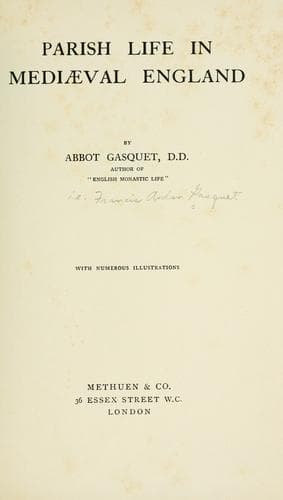
Parish life in mediæval EnglandGasquet, Francis Aidan
History
Parish life in mediæval England
Gasquet, Francis Aidan
England -- Church history -- 1066-1485; England -- Social life and customs -- 1066-1485
The honour and respect shown to the Chrism, which was used by the
bishop at Confirmation, is manifested by the “old silk cloth” and “a
clothe of syndale” used to carry the Chrismatory at St. Mary the Great,
Cambridge. The Chrism was also bound to be renewed every year, the
old being burnt and a new stock procured from what was consecrated on
Maundy Thursday, in every cathedral church. Moreover, when presenting
a child for Confirmation, the parents had to bring with them a linen
band, or napkin, to bind round its head after Confirmation, and cover
the place where it had been anointed. This band, called _Fascia_, or
“Chrism cloth,” was, according to various directions, to be left on
the head of the child three, seven, or eight days, when the lately
confirmed child was to be taken to the church by its parents, and there
have its forehead washed by the priest over the font. The _fasciæ
ligaturæ_, or “Chrism cloths,” were then to be either burnt or left
to the use of the church. Myrc, in his _Instructions_, thus gives the
usage--
“Whenne the chyldre confermed ben
Bondes a-bowte here neckes be lafte
That from hem schule not be rafte
Tyl at chyrche the eghthe day
The preste hymself take hem a-way
Thenne schale he wyth hys owne hondes
Brenne that ylke same bondes,
And wassche the chylde over the font
There he was anoynted in the front.”
Finally, the greatest care was taken not only to see that all
Christians should receive the Sacrament of Confirmation, but that there
should be no doubt as to its valid reception. An instance of this is
to be found in Bishop Brantyngham’s Register. In 1382, some unknown
person, calling himself a bishop, went about the diocese of Exeter
giving the tonsure, and confirming children, and in other ways, as the
bishop says, “putting his sickle into other men’s harvest.” Under these
circumstances, the parents of all children presented for confirmation
to this unknown person were to be warned from every parish pulpit to
come and give evidence, in order that it might be determined what
should be done.
PENANCE.--The Sacrament of Penance, or, in other words, “Confession,”
was obligatory on all at least once a year. The obligation, however,
was obviously not considered the full measure of duty for those who
desired to lead good Christian lives. Bishop Brunton, of Rochester,
in a sermon preached about the year 1388 on the first Sunday of Lent,
whilst laying down the law of Confession at the beginning of Lent,
strongly urges upon his audience the utility of frequently approaching
that Sacrament, but reminds them that a mere formal Confession without
a firm purpose of amendment is worse than useless.
Public-domain text, read in full here on John Shaqi.
Reviews
Reviews
No reviews yet
Be the first to share your thoughts on this work.
Elsewhere in the archive
Join the Discussion
Join the discussion
Sign in to leave a comment or review.
Sign InorCreate an account