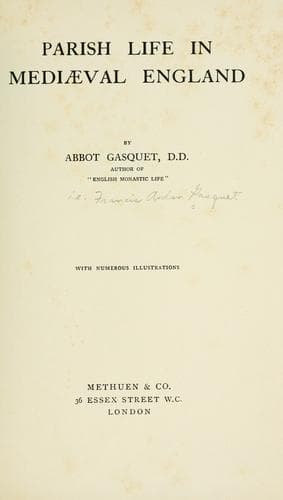
Parish life in mediæval EnglandGasquet, Francis Aidan
History
Parish life in mediæval England
Gasquet, Francis Aidan
England -- Church history -- 1066-1485; England -- Social life and customs -- 1066-1485
The Church house was sometimes let out to tenants and for various
purposes, with a reservation of its use when necessary for parochial
meetings. Thus, at Wigtoft, the rent of the house brought in a
regular sum of money to the churchwardens. At Straton, in the county
of Cornwall, it was let on occasion; as, for instance, in 1513, the
accounts show a receipt of 8_d._ “of Richard Rowell for occupying of
the Church house;” and of 12_d._ “of the paynters for working in the
Church house.” At the annual fair time the Church house was let to
wandering merchants to display their goods. At St. Mary’s, Dover, in
1537, an item of parochial receipt was, “one whole year’s farme of the
churche house in Broad St., 5 shillings.”
Sometimes there was land belonging to the parish, which was let
together with the house; as, for example, at Cratfield, where, in 1534,
an acre of land was let with the “Church house.” Very probably this was
the land on which subsequently the parish shooting-butts were erected.
If there were receipts to the parish, there were, of course, also
expenses for repairs to the common house, which in some accounts appear
to be very frequent, and which shows probably that it was much used. In
one or two instances there seems to have been two floors to the house,
and in one of these instances these were let out separately, one of the
two tenants being a woman.
In many cases it is clear that cooking was done on the premises for the
parish meetings. In some Wiltshire accounts there is evidence of this,
and of utensils of various kinds being kept in the house for parochial
feasting and for ministering to the poor. The householders made merry
and collected money for church purposes, and the younger people had
dancing and bowls in many places, “while the ancients sat gravely by.”
At St. Dunstan’s, in Canterbury, there were two dozen trenchers and
spoons, and one annual dinner is mentioned.
* * * * *
Dr. Jessopp thus speaks of these Church houses--
Public-domain text, read in full here on John Shaqi.
Reviews
Reviews
No reviews yet
Be the first to share your thoughts on this work.
Elsewhere in the archive
Join the Discussion
Join the discussion
Sign in to leave a comment or review.
Sign InorCreate an account