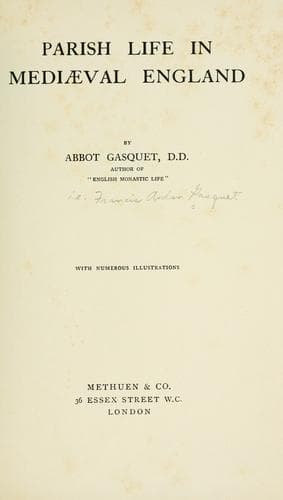
Parish life in mediæval EnglandGasquet, Francis Aidan
History
Parish life in mediæval England
Gasquet, Francis Aidan
England -- Church history -- 1066-1485; England -- Social life and customs -- 1066-1485
“It is hardly a figure of speech,” writes Mr. Booth, in the preface
to this volume, “to say we have in (these rolls) village life
photographed. The dry record of tenures is peopled by men and women
who occupied them, whose acquaintance we make in these records under
the various phases of village life. We see them in their tofts
surrounded by their crofts, with their gardens of pot-herbs. We see
how they ordered the affairs of the village, when summoned by the
bailiff to the vill to consider matters which affected the common weal
of the community. We hear of their trespasses and wrongdoings, and how
they were remedied or punished; of their strifes and contentions, and
how they were repressed; of their attempts, not always ineffective,
to grasp the principle of co-operation as shown by their by-laws;
of their relations with the Prior, who represented the convent, and
alone stood in relation of lord. He appears always to have dealt with
his tenants, either in person or through his officers, with much
consideration; and in the imposition of fines we find them invariably
tempering justice with mercy.”
In fact, as the picture of mediæval village life among the tenants of
the Durham monastery is displayed in the pages of this interesting
volume, it would seem almost as if one was reading of some Utopia of
dreamland. Many of the things that in these days advanced politicians
would desire to see introduced into the village communities of modern
England, to relieve the deadly dulness of country life, were seen
in Durham and Cumberland in full working order in pre-Reformation
days. Local provisions for public health and general convenience
are evidenced by the watchful vigilance of the village officials
over the water supplies, the care taken to prevent the fouling of
useful streams, and stringent by-laws as to the common place for
clothes-washing, and the times for emptying and cleansing ponds and
mill-dams. Labour was lightened and the burdens of life eased by
co-operation on an extensive scale. A common mill ground the corn,
and the flour was baked into bread at a common oven. A common smith
worked at a common forge, and common shepherds and herdsmen watched the
sheep and cattle of various tenants, which were pastured on the fields
common to the whole village community. The pages of the volume contain
numerous instances of the kindly consideration for their tenants which
characterized the monastic proprietors, and the relation between
them was rather that of rentchargers than of men claiming absolute
ownership. In fact, as the editor of the volume says--
Public-domain text, read in full here on John Shaqi.
Reviews
Reviews
No reviews yet
Be the first to share your thoughts on this work.
Elsewhere in the archive
Join the Discussion
Join the discussion
Sign in to leave a comment or review.
Sign InorCreate an account