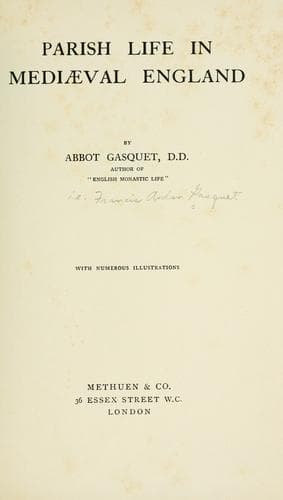
Parish life in mediæval EnglandGasquet, Francis Aidan
History
Parish life in mediæval England
Gasquet, Francis Aidan
England -- Church history -- 1066-1485; England -- Social life and customs -- 1066-1485
“Upon my ryght syde y me laye
Blesid lady to the y prey
For the teres that ye lete
Upon your swete sonnys feete
Send me grace for to slepe
And good dremys for to mete
Slepyng wakyng til morowe daye bee
Our Lorde is the frute, Our Ladye the tree
Blessid be the blossom that sprange lady of thee.
In nomine Patris et Filii et Spiritus Sancti. Amen.”
The inventories of parish churches and the churchwardens’ accounts show
how very common a feature the religious plays--“miracle or mystery
plays,” as they were generally called--were in the village life of the
fifteenth century. It requires very little examination of the “books”
of those plays that have come down to us to see that these sacred
dramas must have been most powerful aids to the religious teaching
of the Church among the simple and unlettered villagers of England,
and even among the crowds which thronged great cities like Coventry,
Chester, and York to witness the traditional acting of the more
elaborate performances.
As to their popularity there can be no question. Dramatic
representations of the chief events in the life of our Lord, etc.,
were intimately associated with the religious purposes for which they
were originally produced. They were played on Sundays and feast-days,
sometimes in the aisles of the churches, in church porches and
churchyards. The author of _Dives and Pauper_ says--
“Spectacles, plays, and dances that are used on great feasts, as
they are done principally for devotion and honest mirth, and to
teach men to love God the more, are lawful if the people be not
thereby hindered from God’s service, nor from hearing God’s word,
and provided that in such spectacles and plays there is mingled no
error against the faith of Holy Church and good living. All other
plays are prohibited, both on holidays and work-days (according to
the law), upon which the gloss saith that the representation in
plays at Christmas of Herod and the Three Kings, and other pieces of
the Gospel, both then and at Easter and other times, is lawful and
commendable.”
There can be no reasonable doubt that such simple dramatic
representations of the chief mysteries of religion and the principal
events in our Lord’s life, or of some incidents in the lives of the
saints, served to impress these truths and fix these events upon the
imaginations of the audiences that witnessed them, and to make them
in the true sense of the words “vivid realities.” The religious drama
was the handmaiden of the Church, and it helped to instruct the people
at large and, quite as much as the painted wall or pictured window,
formed a “book” ever open and easily understood, graphically setting
forth and illustrating truths which formed the groundwork of the formal
instruction in the Sunday sermon.
Public-domain text, read in full here on John Shaqi.
Reviews
Reviews
No reviews yet
Be the first to share your thoughts on this work.
Elsewhere in the archive
Join the Discussion
Join the discussion
Sign in to leave a comment or review.
Sign InorCreate an account