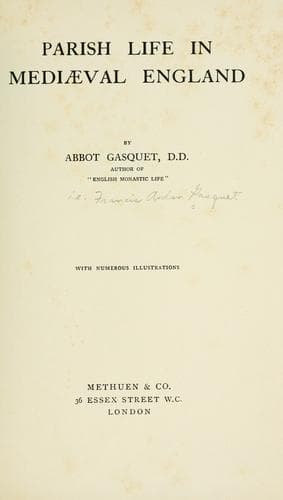
Parish life in mediæval EnglandGasquet, Francis Aidan
History
Parish life in mediæval England
Gasquet, Francis Aidan
England -- Church history -- 1066-1485; England -- Social life and customs -- 1066-1485
At Easter time the churchwardens had to collect “Peter’s pence,” “Rome
fardynges,” “Rome’s scot,” or “Peter farthings,” the contribution from
each household to the Pope. It is well to remark, however, that it
is obvious, from the accounts of this contribution to be found, that
not more than 50 per cent. of the amount collected ever found its way
into the papal coffers. The wardens collected the money and paid it
to the archdeacon at the time of visitation. At St. Mary the Great,
Cambridge, for example, they paid “at ye visytacion, for Rome Fardynges
22½_d._” Great care was taken to secure the punctual payment of
these dues to the Holy See, and warnings were issued when the parish
was in arrears. For continual neglect to pay it was punished with
interdict.
Lastly, there was another very general form of collection made by the
churchwardens, called variously “wax-silver,” “candle-silver,” “Easter
money,” or “Paschal money.” These were payments made in many parishes
towards the annual expenses of the parish in finding candles and
lamps to burn in the churches. In some places the amount paid by each
parishioner was ½_d._ Besides the above, there were various forms of
contribution in different places; as, for example, special payments for
“the holy loaf,” or blessed bread. An examination of the various extant
churchwardens’ accounts will show that these officials were never at a
loss to obtain money from their fellow-parishioners when they needed
it for any special purpose. One great resource, which apparently never
failed them, took the form of social meetings at the Church House, or
elsewhere; but as to these gatherings more will have to be said in a
subsequent chapter.
CHAPTER VII
THE PARISH CHURCH SERVICES
As the church was from the earliest times the centre of the parish, and
the priest the head of his flock and the chief person--the parson--of
the district, it is natural to look for the first indications of all
parochial life in the church itself. From the cradle to the grave, as
it has often been said, through the clergy, religion extended its care
to every soul, and exerted its influence over man, woman, and child
in every parochial district, mainly by means of the Church services
and the administration of the Christian Sacraments. In this and the
following chapter it is proposed to examine the nature and extent of
these influences in pre-Reformation parochial life.
Public-domain text, read in full here on John Shaqi.
Reviews
Reviews
No reviews yet
Be the first to share your thoughts on this work.
Elsewhere in the archive
Join the Discussion
Join the discussion
Sign in to leave a comment or review.
Sign InorCreate an account