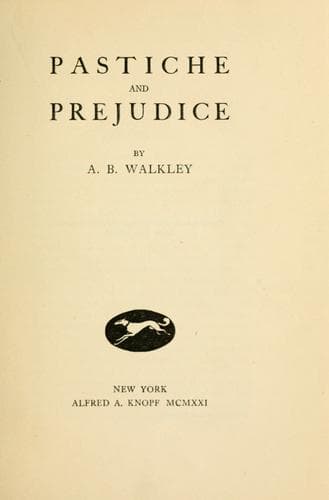
Drama -- History and criticism; English essays -- 20th century; Literature -- History and criticism
As for the Pagello of the new play, the American dramatist has made him
just a tame, hopelessly bewildered donkey. He is provided with a fierce
Italian sweetheart, to bring him back safe, if scolded, from Paris to
Italy. He lives freely on other people’s money, George’s—when it isn’t
Alfred’s. After all, it doesn’t matter, for all the people of the play
are mere travesties of the originals, turned (in the published book
of the play, though not at the Duke of York’s) into modern American
citizens. Buloz talks of “boosting” his subscriptions. Alfred says George
is “like a noisy old clock that won’t stop ticking.” Oh dear!
STENDHAL
In reviewing the performance by the New Shakespeare Company of _King
Henry V._ I was reminded by one of Henry’s lines at Agincourt,
We few, we happy few, we band of brothers,
to speak, it may have seemed a trifle incongruously, of Stendhal. But
it was Stendhal who said, “je n’écris que pour les _happy few_.” No
quotation could have been more appropriate. Stendhal’s readers have
always been few, but they have been enthusiastic. In his lifetime he
was hardly read at all, though Balzac gave him a magnificent “puff”—so
magnificent that even Stendhal himself was taken aback by it and infused
a little irony into his thanks. He supposed himself to be ahead of his
time, and in 1840 said he would be understood somewhere about 1880. It
was rather a good shot, for somewhere about that date there came into
being the fierce tribe of Stendhalians, who founded the “Stendhal Club”
and included in their number no less a man than M. Paul Bourget. But the
vicissitudes of literary reputations are as uncertain as anything in
this world, and M. Bourget wondered what would be thought of Stendhal in
another forty years—namely, in 1920. Well, 1920 has arrived, as the years
have the habit of doing with abominable rapidity, and any one who likes
can seek for an answer to M. Bourget’s question. I will hazard a guess.
I doubt if in the interval there has been very much change in Stendhal’s
position. Now, as in 1880, Stendhal is read, and immoderately loved, by
the “happy few,” and ignored or detested by the rest. But, in enjoying
him, the happy few contrive to take him a little less seriously than did
the Stendhal Club. That process goes on with even greater reputations.
Croce, we are told, takes Dante more lightly than has been the habit
of Italian critics in the last half-century. We English are gradually
learning to discuss Shakespeare as a human being. And here, pat to the
occasion, is a paper on Stendhal in the _Revue de Paris_ by M. Anatole
France, which handles its subject with the easy Anatolian grace we all
know and does, perhaps, at the same time indicate what the readers of
1920 think of Stendhal, though none of them would express their thought
of him with the same charm.
Public-domain text, read in full here on John Shaqi.
Reviews
Reviews
No reviews yet
Be the first to share your thoughts on this work.
Elsewhere in the archive
Join the Discussion
Join the discussion
Sign in to leave a comment or review.
Sign InorCreate an account