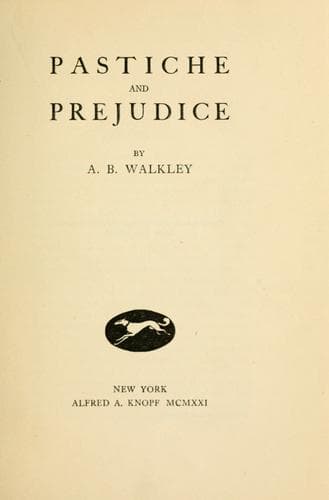
Drama -- History and criticism; English essays -- 20th century; Literature -- History and criticism
We are to understand that it was the domination and the selfishness of
man that created the lamentable type of nineteenth-century “old maid.”
But who were unkindest to Miss Wardle? Her nieces, members of her own
sex. Who created the typical “old maid” and terrible bore, Miss Bates?
Another “old maid,” Jane Austen. The fact is, old maids like other
human beings have their foibles. Are these never to be put into a book?
Feminism seems to make its disciples terribly serious. Miss La Creevy
is Dickens’s example of the _femme artiste_. See, says Mme. Villard,
how types of “independent women” are caricatured! She cannot laugh at
Sairey Gamp and Betsy Prig, because they testify to the social contempt
attaching to the nursing profession at their date! Has it never occurred
to her that novels are sometimes written merely as novels and not as
_dossiers_ in a “case” for the “evolution” of woman?
After all, however, there are plenty of serious novelists who do supply
good evidence—more particularly the quasi-propagandists like Mrs.
Gaskell (when she chose) and Mrs. Humphry Ward (sometimes), and (nearly
always) Mr. Galsworthy and Mr. Wells. Mme. Villard makes effective play
with these. She has no difficulty, for instance, in showing the immense
economic advance of the woman-worker during the last century, though even
here her eye seems too exclusively fixed on her own sex. True, women
were the chief victims of the old “factory” and “sweating” systems, but
the amelioration of their condition, if I am not mistaken, came only as
part of the general amelioration in the condition of “labour,” without
sex-distinction.
Public-domain text, read in full here on John Shaqi.
Reviews
Reviews
No reviews yet
Be the first to share your thoughts on this work.
Elsewhere in the archive
Join the Discussion
Join the discussion
Sign in to leave a comment or review.
Sign InorCreate an account