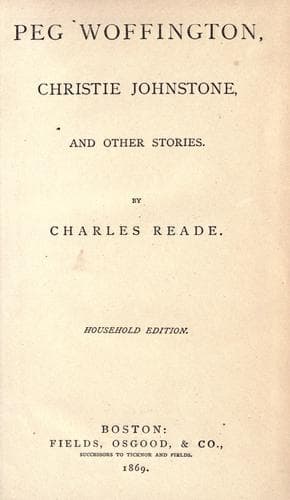
Actresses -- Fiction; Biographical fiction; Great Britain -- History -- 18th century -- Fiction; Woffington, Margaret, -1760 -- Fiction
“Swear this to me,” said the other, almost sternly. “But no. I have more
confidence in that candid face and pure nature than in a human being's
oath. If you are happy, remember you owe me something. If you are
unhappy, come to me, and I will love you as men cannot love.”
Then vows passed between them, for a singular tie bound these two women;
and then the actress showed a part at least of her sore heart to her new
sister; and that sister was surprised and grieved, and pitied her truly
and deeply, and they wept on each other's neck; and at last they were
fain to part. They parted; and true it was, they never met again in this
world. They parted in sorrow; but when they meet again, it shall be with
joy.
Women are generally such faithless, unscrupulous and pitiless humbugs
in their dealings with their own sex--which, whatever they may say, they
despise at heart--that I am happy to be able to say, Mrs. Vane proved
true as steel. She was a noble-minded, simple-minded creature; she was
also a constant creature. Constancy is a rare, a beautiful, a godlike
virtue.
Four times every year she wrote a long letter to Mrs. Woffington; and
twice a year, in the cold weather, she sent her a hamper of country
delicacies that would have victualed a small garrison. And when
her sister left this earthly scene--a humble, pious, long-repentant
Christian--Mrs. Vane wore mourning for her, and sorrowed over her; but
not as those who cannot hope to meet again.
*****
My story as a work of art--good, bad or indifferent--ends with that last
sentence. If a reader accompanies me further, I shall feel flattered,
and he does so at his own risk.
My reader knows that all this befell long ago. That Woffington is gay,
and Triplet sad, no more. That Mabel's, and all the bright eyes of that
day, have long been dim, and all its cunning voices hushed. Judge
then whether I am one of those happy story-tellers who can end with
a wedding. No! this story must wind up, as yours and mine
must--to-morrow--or to-morrow--or to-morrow! when our little sand is
run.
Sir Charles Pomander lived a man of pleasure until sixty. He then
became a man of pain; he dragged the chain about eight years, and died
miserably.
Mr. Cibber not so much died as “slipped his wind”--a nautical expression
that conveys the idea of an easy exit. He went off, quiet and genteel.
He was past eighty, and had lived fast. His servant called him at seven
in the morning. “I will shave at eight,” said Mr. Cibber. John brought
the hot water at eight; but his master had taken advantage of this
interval in his toilet to die!--to avoid shaving?
Snarl and Soaper conducted the criticism of their day with credit and
respectability until a good old age, and died placidly a natural death,
like twaddle, sweet or sour.
Public-domain text, read in full here on John Shaqi.
Reviews
Reviews
No reviews yet
Be the first to share your thoughts on this work.
Elsewhere in the archive
Join the Discussion
Join the discussion
Sign in to leave a comment or review.
Sign InorCreate an account