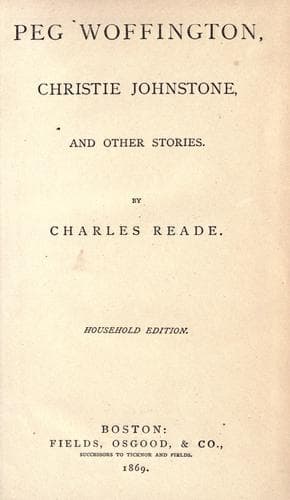
Actresses -- Fiction; Biographical fiction; Great Britain -- History -- 18th century -- Fiction; Woffington, Margaret, -1760 -- Fiction
“When a publican shuts up shop and ceases to diffuse liquid poison, he
does not invite the world to put up the shutters; neither will I.
Actors overrate themselves ridiculously,” added she; “I am not of that
importance to the world, nor the world to me. I fling away a dirty old
glove instead of soiling my fingers filling it with more guineas, and
the world loses in me, what? another old glove, full of words; half
of them idle, the rest wicked, untrue, silly, or impure. _Rougissons,
taisons-nous, et partons.”_
She now changed her residence, and withdrew politely from her old
associates, courting two classes only, the good and the poor. She had
always supported her mother and sister; but now charity became her
system. The following is characteristic:
A gentleman who had greatly admired this dashing actress met one day, in
the suburbs, a lady in an old black silk gown and a gray shawl, with a
large basket on her arm. She showed him its contents--worsted stockings
of prodigious thickness--which she was carrying to some of her
_proteges._
“But surely that is a waste of your valuable time,” remonstrated her
admirer. “Much better buy them.”
“But, my good soul,” replied the representative of Sir Harry Wildair,
“you can't buy them. Nobody in this wretched town can knit worsted hose
except Woffington.”
Conversions like this are open to just suspicion, and some did not fail
to confound her with certain great sinners, who have turned austere
self-deceivers when sin smiled no more. But this was mere conjecture.
The facts were clear, and speaking to the contrary. This woman left
folly at its brightest, and did not become austere. On the contrary,
though she laughed less, she was observed to smile far oftener than
before. She was a humble and penitent, but cheerful, hopeful Christian.
Another class of detractors took a somewhat opposite ground. They
accused her of bigotry for advising a young female friend against the
stage as a business. But let us hear herself. This is what she said to
the girl:
“At the bottom of my heart, I always loved and honored virtue. Yet the
tendencies of the stage so completely overcame my good sentiments that
I was for years a worthless woman. It is a situation of uncommon and
incessant temptation. Ask yourself, my child, whether there is nothing
else you can do, but this. It is, I think, our duty and our wisdom to
fly temptation whenever we can, as it is to resist it when we cannot
escape it.”
Was this the tone of bigotry?
Easy in fortune, penitent, but cheerful, Mrs. Woffington had now but one
care--to efface the memory of her former self, and to give as many years
to purity and piety as had gone to folly and frailty. This was not
to be! The Almighty did not permit, or perhaps I should say, did not
require this.
Public-domain text, read in full here on John Shaqi.
Reviews
Reviews
No reviews yet
Be the first to share your thoughts on this work.
Elsewhere in the archive
Join the Discussion
Join the discussion
Sign in to leave a comment or review.
Sign InorCreate an account