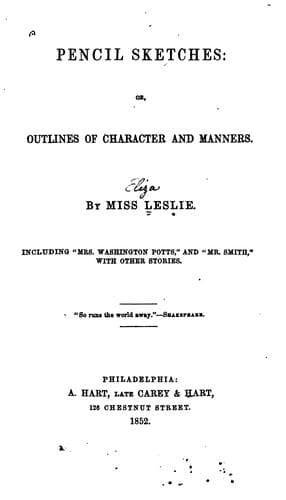
Pencil Sketches; or, Outlines of Character and MannersLeslie, Eliza
General
Pencil Sketches; or, Outlines of Character and Manners
Leslie, Eliza
Humorous stories; Short stories, American; United States -- Social life and customs -- 19th century -- Fiction
His usual costume was an old dusty brown coat, corduroy pantaloons, and
a waistcoat that had once been red, boots that had once been black, and
a low crowned rusty hat--which was never off his head, even in the
presence of the ladies--and a bandanna cravat. The vulgarity of his
habits, and the rudeness of his deportment, all passed off under the
title of eccentricity. At the period when he flourished--it was long
before the time of Sully--the _beau ideal_ of an artist, at least among
the multitude, was an ugly, ill-mannered, dirty fellow, that painted an
inch thick in divers gaudy colours, equally irreconcileable to nature
and art. And the chief attractions of a drawing master--for Mr. Gummage
was nothing more--lay in doing almost everything himself, and producing
for his pupils, in their first quarter, pictures (so called) that were
pronounced "fit to frame."
"Well, madam," said Mr. Gummage, "what do you wish your daughter to
learn? figures, flowers, or landscapes?"
"Oh! all three," replied Mrs. Atmore. "We have been furnishing our new
house, and I told Mr. Atmore that he need not get any pictures for the
front parlour, as I would much prefer having them all painted by
Marianne. She has been four quarters with Miss Julia,[72] and has worked
Friendship and Innocence, which cost, altogether, upwards of a hundred
dollars. Do you know the piece, Mr. Gummage? There is a tomb with a
weeping willow, and two ladies with long hair, one dressed in pink, the
other in blue, holding a wreath between them over the top of the urn.
The ladies are Friendship. Then on the right hand of the piece is a
cottage, and an oak, and a little girl dressed in yellow, sitting on a
green bank, and putting a wreath round the neck of a lamb. Nothing can
be more natural than the lamb's wool. It is done entirely in French
knots. The child and the lamb are Innocence."
[Footnote 72: Miss Julianna Bater, an old Moravian lady, from Bethlehem,
Pennsylvania, who was well known in Philadelphia, many years since, as a
teacher of embroidery.]
"Ay, ay," said Gummage, "I know the piece well enough--I've drawn them
by dozens."
"Well," continued Mrs. Atmore, "this satin piece hangs over the front
parlour mantel. It is much prettier and better done than the one Miss
Longstitch worked, of Charlotte at the tomb of Werter, though she _did_
sew silver spangles all over Charlotte's lilac gown, and used chenille,
at a fi'-penny-bit a needleful, for all the banks and the large tree.
Now, as the mantel-piece is provided for, I wish a landscape for each of
the recesses, and a figure-piece to hang on each side of the large
looking-glass, with flower-pieces under them, all by Marianne. Can she
do all these in one quarter?"
"No, that she can't," replied Gummage; "it will take her two quarters'
hard work, and may be three, to get through the whole of them."
Public-domain text, read in full here on John Shaqi.
Reviews
Reviews
No reviews yet
Be the first to share your thoughts on this work.
Elsewhere in the archive
Join the Discussion
Join the discussion
Sign in to leave a comment or review.
Sign InorCreate an account