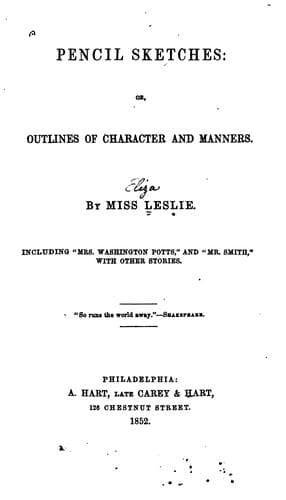
Pencil Sketches; or, Outlines of Character and MannersLeslie, Eliza
General
Pencil Sketches; or, Outlines of Character and Manners
Leslie, Eliza
Humorous stories; Short stories, American; United States -- Social life and customs -- 19th century -- Fiction
Now Mr. Robertson was a man in whose face and figure the most amiable
portrait-painter could have found nothing to commend. He was not what is
called a fine-looking man, for though sufficiently tall, he was gaunt
and ill-proportioned. He was not a handsome man, for every feature was
ugly; and his complexion, as well as his hair, was all of one
ash-colour; though his eyes were much lighter than his skin. He was
fully aware of his deficiency in beauty; but it was some consolation to
him that he had been a very pretty baby, as he frequently took occasion
to mention. With all this, he was extremely ambitious of marrying a
beautiful woman, and resolutely determined that she should "love him for
himself alone." Though in the habit of talking ostentatiously of his
wealth, yet he sometimes considered this wealth as a sort of thorn in
his path to matrimony; for he could not avoid the intrusion of a very
uncomfortable surmise, that were he still poor Jack Robinson, he would
undoubtedly be "cut dead" by the same ladies who were now assiduously
angling for a word or a look from John W. Robertson, Esq. It is true
that, being habitually cautious, he proceeded warily, and dispensed his
notice to the ladies with much economy, finding that, in the words of
charity advertisements, "the smallest donations were thankfully
received."
Having once read a novel, and it being one in which the heroine blushes
all through the book, he concluded that confusion and suffusion were
infallible signs of love, and that whenever the bloom on a lady's cheeks
deepens at the sight of a gentleman, there can be no doubt of the
sincerity and disinterestedness of her regard, and that she certainly
loves him for himself alone. Adopting this theory, Mr. Robertson
determined not to owe his success to any adventitious circumstances; and
he accordingly disdained that attention to his toilet usually observed
by gentlemen in the Coelebs line. Therefore, as the season was summer,
he walked about all the morning in a long loose gown of broad-striped
gingham, buckskin shoes, and an enormous Leghorn hat, the brim turned up
behind and down before. In the afternoon, his flying joseph was
exchanged for a round jacket of sea-grass: and in the evening he
generally appeared in a seersucker coat. But he was invited everywhere.
The mothers flattered him, and the daughters smiled on him, yet still he
saw no blushes. He looked in vain for the "sweet confusion, rosy
terror," which he supposed to be always evinced by a young lady in the
presence of the man of her heart. The young ladies that _he_ met with,
had all their wits about them; and if on seeing him they covered their
faces, it was only to giggle behind their fans. Instead of shrinking
modestly back at his approach, they followed him everywhere; and he has
more than once been seen perambulating the main street of Somerford at
the head of half a dozen young ladies, like a locomotive engine drawing
a train of cars.
Public-domain text, read in full here on John Shaqi.
Reviews
Reviews
No reviews yet
Be the first to share your thoughts on this work.
Elsewhere in the archive
Join the Discussion
Join the discussion
Sign in to leave a comment or review.
Sign InorCreate an account