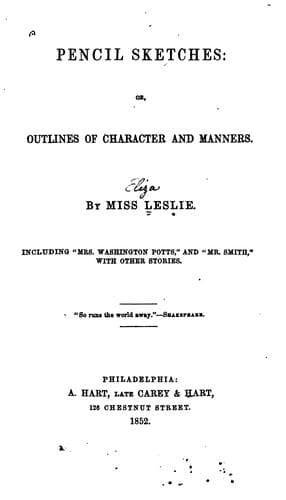
Pencil Sketches; or, Outlines of Character and MannersLeslie, Eliza
General
Pencil Sketches; or, Outlines of Character and Manners
Leslie, Eliza
Humorous stories; Short stories, American; United States -- Social life and customs -- 19th century -- Fiction
One seemingly indispensable instructor brought up the rear of the host
of lecturers, and this was a professor of mnemonics: that is, a
gentleman who gave lessons in memory, pledging himself to furnish the
minds of his pupils with a regular set of springs, which as soon as
touched would instantly unlock the treasures of knowledge that were laid
up in "the storehouse of the brain:" the springs being acted upon by
certain sheets of engraved and coloured hieroglyphics, some of which
were numerical figures, others represented trees and houses, and cats
and dogs, much in the style of what children call primer pictures. Some
of our readers may, perhaps, recollect this professor, who made the
circuit of the Union a few years since.
There seemed but two objections to this system, one being that the
hieroglyphics and their key were harder to remember than the things they
were to remind you of: the other, that they were frequently to be
understood by contraries, like the Hetman in Count Benyowsky, whose
characteristic phraseology is--"When I say the garret, I mean the
cellar--when I tell you to go up, I mean you to come down."
The professor of mnemonics was very unpopular with the ladies, who
asserted, that he had done the gentlemen more harm than good, by so
puzzling their already overcharged heads, that he, in many instances,
destroyed what little memory they had once possessed. This was
particularly the case with regard to Mr. Slowman, who having, at length,
proposed in form to Miss Tremor, and the lady, in her agitation, being
unable at the moment to give him an intelligible answer, he had never
remembered to press his suit any further.
One thing was certain, that since the gentlemen had been taking lessons
in memory, they seemed totally to have forgotten the annual ball.
Yet, as the time drew near, there could be no doubt of its frequently
entering their minds, from their steadily avoiding all reference to the
subject. There was evidently a tacit understanding among them, that it
was inexpedient to mention the ball. But the ice was at last broken by
Gordon Fitzsimmons, as they were all standing round the fire, and
adjusting their cloaks and surtouts, at the close of one of their
society meetings.
"Is it not time," said he, "that we should begin to prepare for the
Christmas ball?"
There was a silence--at last, one of the young gentlemen spoke, and
replied--"that he had long since come to a conclusion that dancing was a
very foolish thing, and that there was something extremely ridiculous in
seeing a room-full of men and women jumping about to the sound of a
fiddle. In short, he regarded it as an amusement derogatory to the
dignity of human nature."
He was interrupted in the midst of his philippic by Fitzsimmons, who
advised him to "consider it not so deeply." Now, Fitzsimmons was himself
an excellent dancer, very popular as a partner, conscious of looking
well in a ball-room, and therefore a warm advocate for "the poetry of
motion."
Public-domain text, read in full here on John Shaqi.
Reviews
Reviews
No reviews yet
Be the first to share your thoughts on this work.
Elsewhere in the archive
Join the Discussion
Join the discussion
Sign in to leave a comment or review.
Sign InorCreate an account