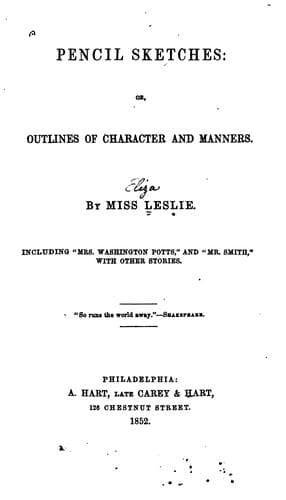
Pencil Sketches; or, Outlines of Character and MannersLeslie, Eliza
General
Pencil Sketches; or, Outlines of Character and Manners
Leslie, Eliza
Humorous stories; Short stories, American; United States -- Social life and customs -- 19th century -- Fiction
The change in Lucinda's countenance and manner was now so obvious that
several of her friends asked her if she was ill. To these questions she
answered in the negative: but her cheeks grew paler, and the tears
sprang to her eyes.
Miss Delwin now approached, and said to her in a low voice--"My dear
Lucinda, I perceive that you are suffering under some _contre-tems_; but
such things, you know, are always incidental to balls, and all other
assemblages where every one expects unqualified delight. We should be
prepared for these contingencies, and when they do occur, the only
alternative is to try to pass them over as well as we can, by making an
effort to rally our spirits so as to get through the remainder of the
evening with apparent composure, or else to plead indisposition and go
home. Which course will you take?"
"Oh! how gladly would I retire!" exclaimed Lucinda, scarcely able to
restrain her tears. "But were I to do so, there are persons who might
put strange constructions--or rather the company might be induced to
make invidious remarks--"
"By no means," interrupted Miss Delwin. "A lady may at any time be
overcome with the heat and fatigue of a ball-room--nothing is more
common."
"But," said Lucinda, "were I to leave the company--were I to appear as
if unable to stay--were I to evince so much emotion--he would, indeed,
suppose me in earnest."
"He!" cried Miss Delwin, looking surprised. "Of whom are you speaking,
dear Lucinda? Who is it that would suppose you in earnest?"
"No matter," replied Lucinda, "I spoke inadvertently; I forgot myself; I
knew not what I was saying."
"Dearest Lucinda," exclaimed Miss Delwin, "I am extremely sorry to find
you so discomposed. What can have happened? At a more convenient time,
may I hope that you will tell me?"
"Oh! no, no," replied Lucinda, "it is impossible. I cannot speak of it
even to you. Ask me no further. I am distressed, humiliated, shocked at
myself (and she covered her face with her hands). But I cannot talk
about it, now or ever."
"Lucinda, my dear Lucinda," said Miss Delwin, "your agitation will be
observed."
"Then I must endeavour to suppress it," replied Lucinda, starting up. "I
_must_ stay till this unfortunate ball is over; my going home would seem
too pointed."
"Let me then intreat you, my dear girl," said Miss Delwin, "to exert
yourself to appear as usual. Come, take my arm, and we will go and talk
nonsense to Apesley Sappington."
Lucinda did make an effort to resume her usual vivacity. But it was
evidently forced. She relapsed continually: and she resembled an actress
that is one moment playing with her wonted spirit, and the next moment
forgetting her part.
"So," said Colonel Kingswood to Fitzsimmons, after Lucinda had left them
together, "I am to infer that you are are really in love with Miss
Mandeville?"
Public-domain text, read in full here on John Shaqi.
Reviews
Reviews
No reviews yet
Be the first to share your thoughts on this work.
Elsewhere in the archive
Join the Discussion
Join the discussion
Sign in to leave a comment or review.
Sign InorCreate an account