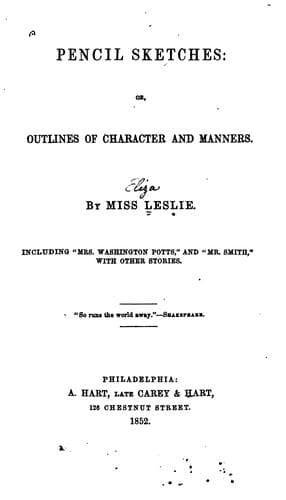
Pencil Sketches; or, Outlines of Character and MannersLeslie, Eliza
General
Pencil Sketches; or, Outlines of Character and Manners
Leslie, Eliza
Humorous stories; Short stories, American; United States -- Social life and customs -- 19th century -- Fiction
When Lucinda Mandeville arrived at her own house, and found herself
alone in her dressing-room, all the smothered emotions of the evening
burst forth without restraint, and leaning her head on the arm of the
sofa, she indulged in a long fit of tears before she proceeded to take
off her ornaments. But when she went to her psyche for that purpose, she
could not help feeling that hers was not a face and figure to be seen
with indifference, and that in all probability the unguarded warmth with
which Fitzsimmons had replied to her mock courtship, was only the
genuine ebullition of a sincere and ardent passion.
It was long before she could compose herself to sleep, and her dreams
were entirely of the ball and of Fitzsimmons. When she arose next
morning, she determined to remain all day up stairs, and to see no
visiters; rejoicing that the fatigue of the preceding evening would
probably keep most of her friends at home.
About noon, Gordon Fitzsimmons, who had counted the moments till then,
sent up his card with a pencilled request to see Miss Mandeville.
Terrified, agitated, and feeling as if she never again could raise her
eyes to his face, or open her lips in his presence, Lucinda's first
thought was to reply that she was indisposed, but she checked herself
from sending him such a message, first, because it was not exactly the
truth, and secondly, lest he should suppose that the cause of her
illness might have some reference to himself. She therefore desired the
servant simply to tell Mr. Fitzsimmons that Miss Mandeville could
receive no visiters that day.
But Fitzsimmons was not now to be put off. He had been shown into one of
the parlours, and going to the writing-case on the centre-table, he took
a sheet of paper, and addressed to her an epistle expressing in the most
ardent terms his admiration and his love, and concluding with the hope
that she would grant him an interview. There was not, of course, the
slightest allusion to the events of the preceding evening. The letter
was conceived with as much delicacy as warmth, and highly elevated the
writer in the opinion of the reader. Still, she hesitated whether to see
him or not. Her heart said yes--but her pride said no. And at length she
most heroically determined to send him a written refusal, not only of
the interview but of himself, that in case he should have dared to
presume that the unfortunate scene at the ball could possibly have meant
anything more than a jest, so preposterous an idea might be banished
from his mind for ever.
Public-domain text, read in full here on John Shaqi.
Reviews
Reviews
No reviews yet
Be the first to share your thoughts on this work.
Elsewhere in the archive
Join the Discussion
Join the discussion
Sign in to leave a comment or review.
Sign InorCreate an account