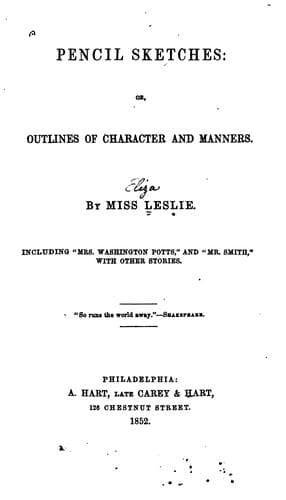
Pencil Sketches; or, Outlines of Character and MannersLeslie, Eliza
General
Pencil Sketches; or, Outlines of Character and Manners
Leslie, Eliza
Humorous stories; Short stories, American; United States -- Social life and customs -- 19th century -- Fiction
It is true, that when the sign came home, the colonel made many
objections to it, declaring that gold breeches had never been worn in
the continental army, and that no man ever stood still leaning on a gun
at the moment it was discharged--neither did he think it by any means a
good likeness of General Wayne. But Mrs. Brigham reminded her husband
that there was no use in telling all this to everybody, and that it
might suit some people's ideas of General Wayne--adding, that she never
saw a sign that _was_ a good likeness, except Timothy Grimshaw's White
Lion, which looked exactly like Timothy himself.
Oliver averred that the artist was certainly a liberal man, and had
given them the full worth of their money, for beside the gilding, there
was more paint on it than on any sign he had ever seen.
Their neighbour, Tempy Walters, was, however, of opinion that they had
been greatly overcharged, for that a man had painted her brother's
cellar-door (which was considerably larger than this sign) for half the
money. "To be sure," added Tempy, "there was no gold on the
cellar-door--but it must have taken twice the paint."
To be brief, the colonel dismissed the case by paying the artist rather
more than he asked--telling him, also, that he should be glad to see him
at his house whenever he chose to come, and that his visits should not
cost him a cent.
There never, perhaps, was a less profitable tavern than the General
Wayne. The people of the neighbourhood were amazingly sober, and Mrs.
Brigham allowed no tipplers to lounge about the bar-room or porch. The
charges were so moderate as scarcely to cover the actual cost of the
good things which were so profusely lavished on the table, and the
family could not relinquish the habit of treating their guests as
visiters and friends. Colonel Brigham always found some reason why such
and such articles were not worth considering at all, and why such and
such people could not afford to pay as well as he could afford to give
them food and shelter. On soldiers, of course, he bestowed gratuitous
entertainment, and was never more delighted than when he saw them
coming. Pedlers and tinmen always took it--and emigrants on their way to
the back settlements were invariably told to keep their money to help
pay for their land.
Public-domain text, read in full here on John Shaqi.
Reviews
Reviews
No reviews yet
Be the first to share your thoughts on this work.
Elsewhere in the archive
Join the Discussion
Join the discussion
Sign in to leave a comment or review.
Sign InorCreate an account