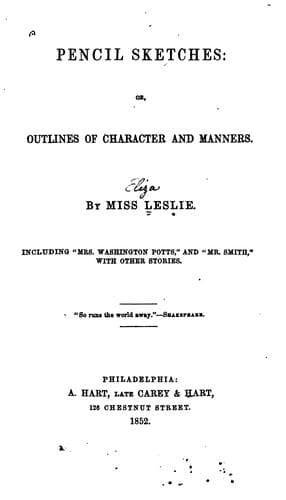
Pencil Sketches; or, Outlines of Character and MannersLeslie, Eliza
General
Pencil Sketches; or, Outlines of Character and Manners
Leslie, Eliza
Humorous stories; Short stories, American; United States -- Social life and customs -- 19th century -- Fiction
The stranger looked at first as if unaccustomed to this question, and
unwilling to answer it. However, after a pause, he deigned to designate
himself as Mr. Culpepper, and slightly mentioned the four young men as
his nephews, the Mr. Lambleys. There was a family likeness throughout
the brothers. They were all tall and slender--all had the same
fawn-coloured hair, the same cheeks of a dull pink, the same smiling
mouths habitually turned up at the corners, and faces that looked as if
all expression had been subdued out of them, except that their
greenish-gray eyes had the earnest intent look, that is generally found
in those of dumb people.
Mr. Culpepper was conducted into a parlour, where (though the evening
was far from cold) he expressed his satisfaction at finding a fire. He
deposited on the broad mantel-piece a small red morocco box which he had
carried under his arm, and while his nephews (who had all been to see
the baggage deposited) were engaged in disrobing him of his extra
habiliments, he addressed himself to Colonel Brigham, whom he seemed to
regard with particular complaisance.
"Well, landlord," said he; "you are, perhaps, surprised at my stopping
here?"
"Not at all," said the colonel.
"The truth is," pursued Mr. Culpepper, "I am travelling for my health,
and therefore I am taking cross-roads, and stopping at out of the way
places. For there is no health to be got by staying in cities, and
putting up at crowded hotels, and accepting invitations to
dinner-parties and tea-parties, or in doing anything else that is called
fashionable."
"Give me your hand, sir," said Colonel Brigham; "you are a man after my
own heart!"
The four Mr. Lambleys stared at the landlord's temerity, and opened
their eyes still wider when they saw it taken perfectly well, and that
their uncle actually shook hands with the innkeeper. This emboldened
them to murmur something in chorus about their all disliking fashion.
"And pray," said old Culpepper, "why should you do that? 'Tis just as
natural for young people to like folly, as it is for old people to be
tired of it. And I am certain you have never seen so much of fashion as
to be surfeited with it already."
The nephews respectfully assented.
It had already come to the knowledge of Mrs. Brigham (who was busily
occupied up stairs in filling with new feathers some pillow-ticks which
Fanny was making) that a party of distinguished strangers had arrived.
"Fanny, Fanny," she exclaimed, opening the door of the adjoining room,
in which Fanny was seated at her sewing, "there are great people below
stairs. Get fixed in a moment, and go down and speak to them. I am glad
your father has had sense enough to take them into the front parlour."
"But, mother," replied Fanny, "I saw them from the window when they got
out of the stage. They are all men people, and I know I shall be
ashamed, as they are quite strange to me, and I suppose are very great
gentlemen. Won't it suit better for you to go?"
Public-domain text, read in full here on John Shaqi.
Reviews
Reviews
No reviews yet
Be the first to share your thoughts on this work.
Elsewhere in the archive
Join the Discussion
Join the discussion
Sign in to leave a comment or review.
Sign InorCreate an account