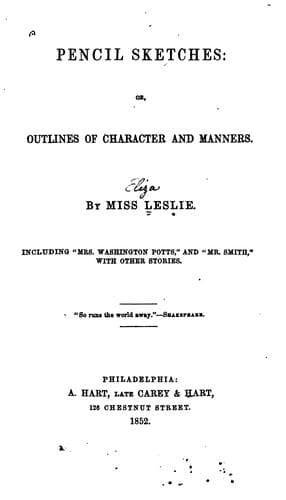
Pencil Sketches; or, Outlines of Character and MannersLeslie, Eliza
General
Pencil Sketches; or, Outlines of Character and Manners
Leslie, Eliza
Humorous stories; Short stories, American; United States -- Social life and customs -- 19th century -- Fiction
As soon as they were entirely out of hearing, Colonel Brigham, who had
with difficulty restrained himself, broke out into a laugh, but Oliver
traversed the room indignantly.
"I have no patience," said he, "with such fellows. To think that
full-grown men--men that have hands to work and get their own living,
should humble themselves to the dust, and submit to be treated as
lacqueys by an old uncle (or, indeed, by anybody), merely because he
happens to be rich, and they expect to get his money when he sees proper
to die, which may not be these twenty years, for it is plain that
nothing ails him. 'I'd rather be a dog and bay the moon,' as I once
heard an actor say in the Philadelphia play-house. Now I talk of
Philadelphia; I have engaged all our next barley to Wortley & Hopkins.
They pay better than Maltman & Co. But these Lambleys, Sheepleys
rather--I saw them from the barn, handing the old fellow out of the
stage. I almost expected to see them lift his feet for him; I was glad
he scattered them all as soon as he had got down the steps. I dare say
if he rides on horseback, they all four run beside him and hold him on
his horse. Now I talk of horses, I've concluded to keep the two bay
colts, and raise them myself. Tom Martingale shall not have them for the
price he offers. To see how these chaps fetch and carry, and rise up and
sit down, just at that old fellow's beck. It would be harder work for me
than following the plough from sunrise to sunset, were I obliged to do
so. Now I talk of ploughing; I bought another yoke of oxen yesterday,
and hired a Dutchman. I shall put the five-acre field in corn. That old
villain! you may see by his eye that he is despising them all the time.
Why should not he? ninnies as they are. I wonder where they all came
from? I do not believe they are Americans."
"And yet," said Colonel Brigham, "they do not speak like Englishmen, and
I am sure they are neither Scotch nor Irish."
"I hear them all pacing about up stairs in the old fellow's room," said
Oliver; "think of four men putting one man to bed, or of any one man
allowing four to do it. But 'their souls are subdued to what they work
in,' as I heard another play-actor say. By-the-bye, the old rogue has
forgotten his red box, and left it on the mantel-piece. I wonder what is
in it?"
"Maybe it is full of gold money," said Mrs. Brigham, who had just
entered the room with Fanny; the daughter proceeding to put back the
chairs, while the mother swept up the hearth.
"Bank notes rather," said Oliver.
"Jewels, I think," said Fanny.
"Deeds of property, perhaps," said the colonel.
"Well, well," said Mrs. Brigham, "'tis time for all good people to be in
bed, so we'll let the strangers and their box rest till to-morrow."
"I think," observed the colonel, "the box had best be carried up to
them. Take it, Oliver."
"I just heard the young men leave their uncle's room to go to their
own," said Mrs. Brigham. "May be it won't do to disturb him, now he's in
bed."
Public-domain text, read in full here on John Shaqi.
Reviews
Reviews
No reviews yet
Be the first to share your thoughts on this work.
Elsewhere in the archive
Join the Discussion
Join the discussion
Sign in to leave a comment or review.
Sign InorCreate an account