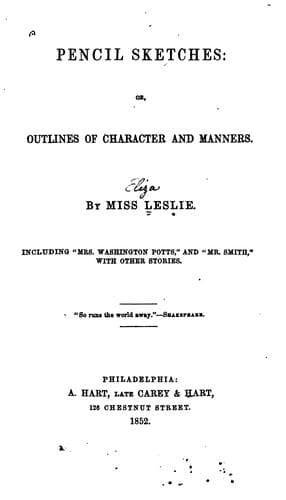
Pencil Sketches; or, Outlines of Character and MannersLeslie, Eliza
General
Pencil Sketches; or, Outlines of Character and Manners
Leslie, Eliza
Humorous stories; Short stories, American; United States -- Social life and customs -- 19th century -- Fiction
The old gentleman walked about in much perturbation. At last he said to
the Lambleys, "Young men, as you took a most nefarious method of
discovering my intentions towards you, and as I never had a doubt
respecting the real motive of all your obsequiousness to me, there is no
use in attempting any farther disguise on either side. When masks are
only of gauze, it is not worth while to wear them. Try then if you can
be natural for a little while, till I see what can be done with you. You
will find it best in the end. And now, I think, we will go away as soon
as possible. The longer I stay here, the more difficult I shall find it
to leave Oliver."
To be brief.--Mr. Culpepper and his nephews departed in about an hour,
in a vehicle belonging to the General Wayne, and which was to carry them
to the nearest village from whence they could proceed to New York.
At parting, Mr. Culpepper held out his hand and said, "Oliver, for once
call me grandfather."
Oliver pressed his hand, and said, "Grandfather, we part friends." The
old gentleman held his handkerchief to his eyes, as he turned from the
door, and his nephews looked nohow.
In about a month, Oliver received a parcel from Mr. Culpepper,
containing the little red morocco box, in which was a letter and some
papers. The letter was dated from New York. The old gentleman informed
his grandson, that he had been so fortunate as to engage the affections
and obtain the hand of a very beautiful young lady of that city (the
youngest of eight sisters, and just entering her seventeenth year), who
had convinced him, that she married only from the sincerest love.
Finding no farther occasion for his nephews, he had established them
all in business in New York, where no doubt they would do better than in
Canada. He sent Oliver certificates for bank stock to a considerable
amount, and requested him, whenever he wanted more money for the
enlargement or improvement of the farm, to apply to him without scruple.
This letter arrived on the day of Oliver's marriage with Fanny; on which
day the sign of the General Wayne was taken down, and the tavern became
once more a farm-house only; Mrs. Brigham having been much troubled by
the interruptions she sustained from customers, during her immense
preparations for the wedding, and determining that on the great occasion
itself, she would not be "put out" by the arrival of any guest, except
those that were invited.
Colonel Brigham, never having approved of the sign, was not sorry to see
it removed; and Mrs. Brigham, thinking it a pity to have it wasted, made
it do duty in the largest bedchamber as a chimney-board.
In a few years the Colonel found sufficient employment for most of his
time in playing with Fanny's children, and such was his "green old age,"
that when upwards of seventy, he was still able to take the
superintendence of the farm, while Oliver was absent at the seat of the
state government, making energetic speeches in the capacity of an
assembly-man.
Public-domain text, read in full here on John Shaqi.
Reviews
Reviews
No reviews yet
Be the first to share your thoughts on this work.
Elsewhere in the archive
Join the Discussion
Join the discussion
Sign in to leave a comment or review.
Sign InorCreate an account