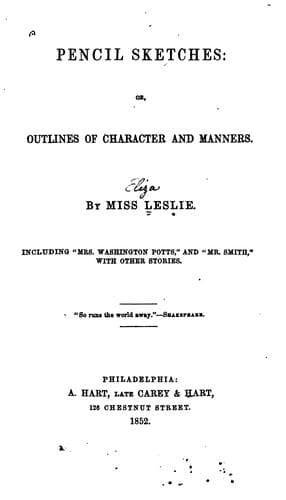
Pencil Sketches; or, Outlines of Character and MannersLeslie, Eliza
General
Pencil Sketches; or, Outlines of Character and Manners
Leslie, Eliza
Humorous stories; Short stories, American; United States -- Social life and customs -- 19th century -- Fiction
"I fear these pacific feelings are too sudden to be lasting," remarked
Miss Clements, "and in a day or two we shall find that 'your voice is
still for war.'"
* * * * *
The following morning the young ladies did more sewing than on any day
for the last two years, sitting all the time in the back parlour. In the
afternoon, Harriet read Coelebs aloud to her mother and aunt, and
Caroline went out to do some shopping. When she came home, she told of
her having stopped in at Mrs. Raymond's, and of her finding the family
just going to tea with an officer as their guest. "They pressed me
urgently," said she, "to sit down and take tea with them, and to remain
and spend the evening; but I steadily excused myself, notwithstanding
the officer."
"Good girl!" said Sophia.
"To be sure," added Caroline, "he was only in a citizen's dress."
"Ah!" said Mrs. Darnel, "that materially alters the case. Had he been in
uniform, I am sure your steadiness would have given way."
In less than two days all their anti-military resolutions were overset,
and the young ladies were again on the _qui vive_, in consequence of the
promulgation of an order for the return of the volunteers from Camp
Dupont, as, the winter having set in, the enemy had retired from the
vicinity of the Delaware and Chesapeake. The breaking up of this
encampment was an event of much interest to the inhabitants of
Philadelphia, as there were few of them that had not a near relative, or
an intimate friend among those citizen-soldiers.
On the morning that they marched home all business was suspended; the
pavements and door-steps were crowded with spectators, and the windows
filled with ladies, eager to recognise among the returning volunteers
their brothers, sons, husbands, or lovers,--who, on their side, cast
many upward glances towards the fair groups that were gazing on them.
The British General Riall, who had been taken prisoner at the battle of
Niagara, chanced to be at a house on the road-side when this gallant
band went by, on their way to Philadelphia. It is said that he remarked
to an American gentleman near him, "You should never go to war with
us--the terms are too unequal. Men like these are too valuable to be
thrown away in battle with such as compose _our_ armies, which are
formed from the overflowings of a superabundant population; while here I
see not a man that you can spare."
And he was essentially right.
Public-domain text, read in full here on John Shaqi.
Reviews
Reviews
No reviews yet
Be the first to share your thoughts on this work.
Elsewhere in the archive
Join the Discussion
Join the discussion
Sign in to leave a comment or review.
Sign InorCreate an account