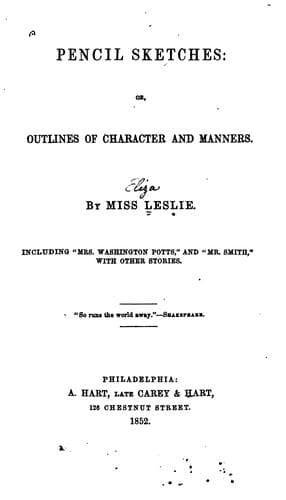
Pencil Sketches; or, Outlines of Character and MannersLeslie, Eliza
General
Pencil Sketches; or, Outlines of Character and Manners
Leslie, Eliza
Humorous stories; Short stories, American; United States -- Social life and customs -- 19th century -- Fiction
In the early part of the present century, there lived in one of the long
streets in the south-eastern section of Philadelphia, a tailor, whom we
shall introduce to our readers by the name of Peter Jones. His
old-fashioned residence, which (strange to say) is yet standing, was not
then put out of countenance by the modern-built structures that have
since been run up on each side of it. There were, it is true, three or
four new houses nearly opposite, all of them tenanted by genteel
families--but Peter's side of the way (at least for the length of a
square), was yet untouched by the hand of improvement, his own domicile
being the largest and best in the row, and moreover of three stories--an
advantage not possessed by the others. It had a square-topped door
lighted by three small square panes--the parlour window (there was but
one) being glazed to match, also with small glass and heavy wood work.
The blue-painted wooden door-step was furnished with a very convenient
seat, denominated the porch, and sheltered above by a moss-grown
pent-house. The whole front of the mansion was shaded by an enormous
buttonwood tree, that looked as if it had been spared from the primeval
forest by the axe of a companion of William Penn. The house, indeed,
might have been the country seat of one of the early colonists. Under
this tree stood a pump of excellent water.
Adjoining to the house was a little low blue frame, fronting also the
street--and no ground speculator could pass it without sighing to think
that so valuable a lot should be thus wasted. But Peter Jones owned both
house and shop--his circumstances were comfortable, his tastes and
ideas the reverse of elegant, and he had sense enough to perceive that
in attempting a superior style of life he should be out of his element,
and therefore less happy. Assisted at times by a journeyman, he
continued to work at his trade because he was used to it, and that he
might still have the enjoyment of making clothes for three or four
veterans of the revolution; and also for two old judges, who had been in
Congress in those sensible times when that well-chosen body acted more
and talked less. All these sexagenarians, having been enamoured of Peter
Jones's cut when he was the Watson of his day, still retained their
predilection for it; liking also to feel at ease in their own clothes,
and not to wear garments that seemed as if borrowed from "the sons of
little men." These gentlemen of the old school never passed without
stopping at the shop window to chat a few words with Peter; sometimes
stepping in, and taking a seat on his green Windsor chair--himself
always occupying the shop-board, whether he was at work or not.
Public-domain text, read in full here on John Shaqi.
Reviews
Reviews
No reviews yet
Be the first to share your thoughts on this work.
Elsewhere in the archive
Join the Discussion
Join the discussion
Sign in to leave a comment or review.
Sign InorCreate an account