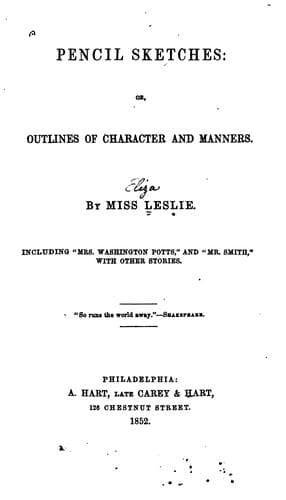
Pencil Sketches; or, Outlines of Character and MannersLeslie, Eliza
General
Pencil Sketches; or, Outlines of Character and Manners
Leslie, Eliza
Humorous stories; Short stories, American; United States -- Social life and customs -- 19th century -- Fiction
When the equestrian robbers appeared one by one galloping across the
distant mountains, and Mrs. Jones had carefully counted them all to
ascertain that there was the full complement of exactly forty, Miss
Flimbrey laughed, and assured her that in reality there were only three,
one mounted on a black, one on a bay, and one on a white horse, but they
passed round and appeared again, till the precise number was
accomplished. "And the same thing," said she, "is always done when an
army marches across the stage, so that a few soldiers are made to seem
like a great many."
"You perceive, Mrs. Jones," said Mr. Dodcomb, "these robbers that ride
over the distant mountains are not the real men; but both man and horse
is nothing more than a flat thin piece of wood painted and cut out."
On Peter remarking that there was certainly a look of life or reality in
the near leg of each rider as it was thrown over the saddle, Mr. Dodcomb
explained that each of these equestrian figures was carried by a man
concealed behind, and that one arm of the man was thrust through an
aperture at the top of the painted saddle; the arm that hung over so as
to personate a leg, being dressed in a Turkish trowser, with a boot
drawn on the hand.
"Do you mean," said Peter, "that these men run along the ridge, each
carrying a horse under his arm?"
"Exactly so," replied Dodcomb, "the horse and rider of painted board
being so arranged as to hide the carrier."
"Well--I never did hear anything so queer," said Mrs. Jones, "I wonder
how they can keep their countenances. But, there are so many queer
things about play-acting. Dear me! what a pug-nose that cobbler has! Let
me look at the bill and see who he is--why I saw the same man in the
play, and his nose was long and straight."
"Oh! when he wants a snub nose," replied Miss Flimbrey, "he ties up the
end with a single horse-hair fastened round his forehead, and the horse
hair is too fine to be seen by the audience."
During the scene in which Morgiana destroys the thieves, one at a time,
by pouring a few drops of the magic liquid into the jars in which they
are hidden, Mrs. Jones found out of her own accord that the jars were
only flat pieces of painted board; but Mrs. Dodcomb made her observe
that as each of the dying bandits uttered distinctly his own separate
groan, the sound was in reality produced from the orchestra, by he of
the bass viol giving his bow a hard scrub across the instrument.
"Well," said Mrs. Jones on her way home, "now that my eyes are opened, I
must say there is a great deal of deception in plays."
Public-domain text, read in full here on John Shaqi.
Reviews
Reviews
No reviews yet
Be the first to share your thoughts on this work.
Elsewhere in the archive
Join the Discussion
Join the discussion
Sign in to leave a comment or review.
Sign InorCreate an account